
India's digital backbone has changed how the country does business. A billion broadband connections, a payments network that handles hundreds of millions of transactions every day, and fast-growing computing capacity now sit underneath the economy. For companies exploring India market entry, digital infrastructure in India is a strong draw. It also changes what a good plan looks like. This blog looks at the official numbers and what they mean for anyone entering the Indian market.
The government’s own data shows how quickly the base has grown.
Connectivity.
According to TRAI, broadband subscribers crossed 100 crore (one billion) in November 2025, up from about 13 crore a decade earlier. The Ministry of Communications reports average monthly data use of 24 GB per wireless subscriber, with median mobile speeds above 130 Mbps. TRAI’s July 2026 data also shows 5G fixed wireless connections at 13.21 million, with rural areas making up just over half of them.
Payments.
The Ministry of Finance says UPI handled over 24,162 crore transactions in FY 2025-26, worth roughly ₹314 lakh crore, across 703 banks. About 86% of person-to-merchant payments were below ₹500, which shows how deeply it has reached everyday commerce.
Computing.
MeitY has told Parliament that data centre capacity rose from 375 MW in 2020 to about 1,575 MW. Under the IndiaAI Mission, shared compute has crossed 45,000 GPUs.
Investors have noticed. DPIIT data shows foreign investment in India reached about US$58.8 billion in equity inflows in FY 2025-26. Computer software and hardware was the top sector at US$13.9 billion, up from US$7.8 billion a year earlier.
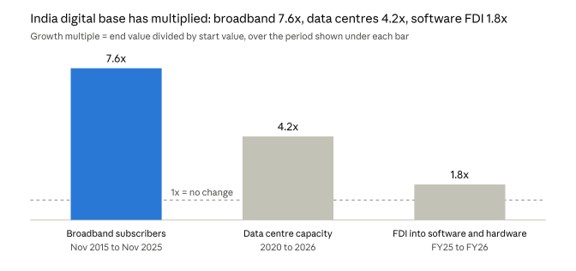
Multiples computed from TRAI (broadband subscribers, Nov 2015 to Nov 2025), MeitY (data centre MW, 2020 to 2026) and DPIIT (software and hardware FDI equity, FY25 to FY26).
Strong digital infrastructure lowers the cost of reaching Indian customers and shortens the first year of operations. A company can onboard customers online, collect payments instantly and serve users across states from a single cloud region. That is one reason computer software and hardware leads foreign investment inflows. The same rails also support e-commerce, logistics tracking and digital invoicing, so the benefits reach manufacturing, retail, healthcare and services as well.
Consider a European retail-software company that sells inventory and billing tools to small shops. In India, it can assume its customers are already online, accept UPI from day one, and host its product in a Mumbai or Hyderabad data centre region close to users. Its main task is no longer building infrastructure. It is adapting pricing to small-ticket payments, localising the product, and meeting data-handling rules. This is an illustration, but it reflects a real pattern: strong digital infrastructure lowers the cost of reaching customers while raising their expectations.
Digital infrastructure in India is strong, but it is uneven. TRAI data shows the top five providers hold about 98.6% of broadband subscribers, so provider choice can be limited in some areas. Data centre capacity sits in a handful of hubs and MeitY notes that power availability is a key factor when operators pick locations. Build resilience into your plans: use more than one vendor where possible, test performance in your target cities, and keep local support close to customers.
A sound India market entry strategy ties these points together. Test demand with a pilot, pick a city hub that suits your customers, choose the right entry structure (subsidiary, joint venture or distributor), and set up tax, legal and compliance processes before launch. Timing matters too. A pilot can go live online quickly, but incorporation, tax registration and banking take longer, so start those workstreams in parallel. Digital infrastructure makes it quicker to reach customers, but careful planning still decides who succeeds.
UJA Global Advisory helps international companies shape their India market entry strategy, from market research and entry structure to incorporation, tax and compliance. Talk to our team to discuss your plans.