Read Time: 6 min

Market Reports

India’s Oil and Gas Industry

India’s Oil and Gas Industry

Quick Facts: India’s Oil and Gas Industry

  • As of March 2025, India is the third-largest consumer of oil worldwide
  • In FY 2024–25, India produced 28.7 Million Metric Tons (MMT) of crude oil and 36.1 Billion Cubic Meters (BCM) of natural gas
  • India’s pipeline infrastructure spans 10,443 km of crude oil pipelines and 24,130 km of petroleum product pipelines, supporting efficient fuel transport
  • In early 2025, the Oil & Natural Gas Corporation (ONGC) initiated more than 45 exploration and development wells along with the expansion of Dabhol LNG capacity from 5 to 6.3 MMT per annum
  • The Indian government aims to increase natural gas’ share in the energy mix from 6% to 15% by 2030, highlighting India’s energy security, diversification and sustainability objectives
  • India operates 23 refineries with a total installed capacity of 258.1 MMT per annum, ranking as the 4th-largest refining hub in the world
  • The country has 8 LNG terminals with 52.7 MMT per annum regasification capacity, making India the 4th-largest LNG importer worldwide
  • A vast network of 96,724 petroleum retail outlets provides nationwide fuel accessibility
  • With over 329 million domestic LPG consumers, India is the 3rd-largest LPG market globally
  • India is pushing for a widespread transition to gas, aiming for 126.3 million PNG connections and 18,336 CNG stations by 2034, with state policies already driving a 25% increase in CNG vehicle adoption

Overview of Indian Oil and Gas Industry

India’s oil and gas sector is characterized by rising demand, high import dependency and systemic reforms aimed at achieving energy security and diversification. As the world’s fourth-largest refining hub, India is strategically expanding its capacity to 309.5 MMT per annum by 2028, balancing domestic needs with growing exports. The government is actively seeking to attract foreign investment through policies like 100% FDI in segments including natural gas, refineries and petroleum products, coupled with simplified exploration & production (E&P) rules, successfully reducing administrative hurdles.

Additionally, significant resources are being channelled into upstream exploration, with plans to increase the total exploration area to 1 million sq. kms by 2030, supported by new gas pricing reforms. Crucially, the sector is spearheading the energy transition through the National Green Hydrogen Mission and accelerating the 20% ethanol blending target to 2025-26, positioning the industry for a sustainable future.
India’s Oil and Gas Industry – Major Players

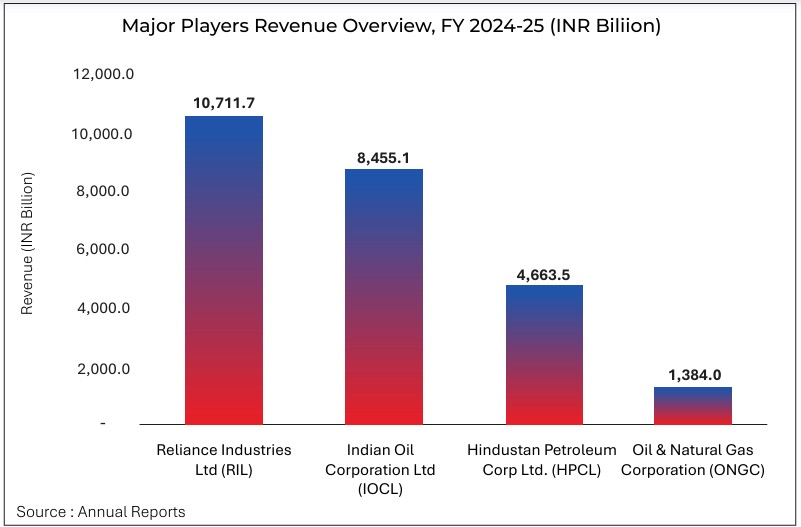
Reliance Industries Limited (RIL):

  • Reliance is India’s largest private refiner with the world’s biggest refining complex at Jamnagar, holding about 27.6% share of total refining capacity.
  • Company’s O2C (Oil-to-Chemical) segment operates a 1.4 million barrels per day (MBPD) refining capacity at Jamnagar.

Indian Oil Corporation Ltd (IOCL):

  • IOCL is the largest refiner in India, operating 10 major refineries with a combined capacity of 80.7 MMT per annum, accounting for about 31% of India’s total refining capacity.
  • It also operates a vast pipeline network, including ~50% of India’s crude pipelines.
  • IOCL accounts for approximately ~33% of the country’s crude and product pipeline capacity.

Hindustan Petroleum Corporation Ltd (HPCL):

  • HPCL’s refineries processed 25.3 MMT of crude in FY 2024–25, marking a 13.2% YoY increase and a record for the company.
  • Pipeline throughput also reached a record 26.9 MMT, enhancing midstream competitiveness.

Oil & Natural Gas Corporation (ONGC):

  • ONGC contributes around 71% of India’s domestic oil and gas output, far outpacing other explorers and producers.
  • The Government of India held a 58.9% stake in ONGC as of 30 September 2025.
  • Strategic partnerships, such as with BP Group to increase production at the Mumbai High field in January 2025, show ONGC’s role in managing mature assets and boosting output potential.
  • ONGC dominates India’s crude and product pipeline infrastructure with an estimated ~41% share of total pipeline capacity.

Government Initiatives

Hydrocarbon Exploration and Licensing Policy (HELP)

  • The Government launched HELP, a unified policy framework, in 2016, for granting exploration and production licences for all forms of hydrocarbons.
  • HELP institutionalized Open Acreage Licensing Policy (OALP), allowing companies to nominate blocks of interest at any time, without waiting for periodic government bidding rounds.
  • Under this initiative, 172 exploration blocks across Rounds I–IX have been awarded, covering 378,652 sq. km.
  • OALP Round X, offering 25 exploration blocks over 191,986 sq. km, was launched on 15 April 2025.

Petroleum and Natural Gas Rules, 2025

  • In December 2025, through the Petroleum and Natural Gas Rules 2025, the government aims to streamline the country’s oil and gas sector to boost investment.
  • Introduced under the Oilfields (Regulation and Development) Amendment Act, 2025, the rules replace multiple approvals with a single petroleum lease covering exploration, development and production of both conventional and unconventional hydrocarbons.
  • Leases can be granted for up to 30 years and extended for the full economic life of a field, offering long-term visibility to investors.

Pradhan Mantri Ujjwala Yojana (PMUY)

  • Under this scheme, as of July 2025, over 100 million LPG connections were provided to women from below-poverty-line households.
  • LPG demand increased by 51% between 2015 and 2023, translating to an annual growth rate of about 5.3%.
  • The Union Cabinet has approved a targeted LPG subsidy of INR 300 per 14.2 kg cylinder for beneficiaries of the Pradhan Mantri Ujjwala Yojana (PMUY) for FY 2025–26. The subsidy will be available for up to nine refills per household per year, with a proportionate benefit for 5 kg cylinders. The total expenditure for this initiative is estimated at INR 120 billion.

Ethanol Blending Program (EBP)

  • The National Policy on Biofuels, 2018, sets an indicative target of achieving 20% ethanol blending in petrol under the Ethanol Blended Petrol (EBP) Programme by 2030.
  • Implemented nationwide to promote the use of alternative, environmentally friendly fuels, while reducing India’s dependence on imported energy.
  • Over the last decade (up to 31 December 2024), ethanol blending by public sector Oil Marketing Companies has resulted in foreign exchange savings exceeding INR 1,130 billion and crude oil substitution of around 19.3 MMT.

National Green Hydrogen Mission (NGHM)

  • Launched in 2023, the National Green Hydrogen Mission (NGHM) aims to build a robust green hydrogen ecosystem in India and address sector-wide opportunities and challenges.
  • The Mission is built around four core pillars: a supportive policy and regulatory framework, creation of domestic demand, strong focus on research, development and innovation and the development of enabling infrastructure and ecosystems.
  • By 2030, the Mission targets deployment of around 125 GW of renewable energy for green hydrogen, backed by investments exceeding INR 8 lakh crore (INR 8 trillion).
  • The initiative is expected to generate over 6 lakh jobs, reduce fossil fuel imports by INR 1 lakh crore (INR 1 trillion) and cut 50 MMT of greenhouse gas emissions annually by 2030.

Megatrends in the Oil and Gas Industry

Increasing Shift Towards Gas-Based Economy

  • The government is aggressively pushing to increase the share of natural gas in India’s energy mix from ~6.7% to 15% by 2030.
  • India’s operational natural gas pipeline network has reached approximately 25,000 km, with another 10,800 km under construction.
  • Natural gas consumption is forecast to grow by nearly 60% by 2030, reaching 103 BCM/year.

Digital Transformation and Advanced Technologies

  • Adoption of Digital Twins and AI-driven predictive maintenance is reducing machine downtime by an estimated 20% to 40%.
  • Cloud migration offers significant cost advantages, with most oil and gas companies realizing 30–40% reductions in IT infrastructure costs through cloud adoption.
  • Companies like Oil India Limited (OIL) have launched projects like DRIVE 2.0, integrating command centers for real-time well monitoring and drone surveillance for asset security.

Deployment of CCUS (Carbon Capture, Utilization & Storage)

  • The Government of India has committed to reducing CO2 emissions by 50% by 2050 and reaching net zero by 2070.
  • Emergence of “CCUS Hubs” in industrial clusters like the Krishna-Godavari Basin and Gujarat. The Krishna–Godavari Basin has an estimated CO₂ EOR storage capacity of 658.7 million tons.
  • NITI Aayog targets a carbon capture capacity of 750 million tons per year by 2050.

Russia Crude Dynamics

  • India continues to remain highly reliant on Russian crude, which accounted for around 34% of total crude imports in September 2025, equivalent to approximately 1.6 million barrels per day.
  • Sustained geopolitical pressure and trade restrictions on Russia have kept Russian crude available at discounted prices, enabling India to strategically increase sourcing and optimize its import basket.
  • Elevated global crude inventories and constrained demand growth are expected to keep oil prices subdued, with benchmark crude projected to average USD 55–60 per barrel (INR 4,950–5,940 per barrel) through 2026, reflecting a structural supply surplus.
  • Indian public sector refiners such as IOC, BPCL and HPCL are well positioned to benefit, as lower crude procurement costs support stronger gross refining margins and earnings outlook.

Why Invest in India’s Oil and Gas Industry?

Rapidly Growing Domestic Energy Demand

  • India’s oil demand is rising sharply, with estimates projecting growth of ~220,000 barrels per day in 2024, bringing total consumption to 5.6 MBPD and continuing upward momentum in subsequent years.
  • India’s domestic consumption of petroleum products stood at 239.2 MMT per annum in FY2025. 
  • India remains one of the world’s fastest-growing energy markets, driven by economic expansion and transport/industrial fuel requirements.

Strong Policy Support and Liberalised Investment Framework

  • The government has allowed 100% Foreign Direct Investment (FDI) in upstream and private sector refining projects, making entry easier for global energy firms.
  • From April 2000 to March 2025, the sector attracted INR 43.9 billion in FDI, indicating a strong signal of foreign investor confidence.
  • Major legislative amendments were introduced in 2025 to boost exploration by offering policy stability, international arbitration and extended lease terms.

Transition to Natural Gas & Biofuels Creates New Growth Avenues

  • Natural gas production in India increased from 92.2 Million Metric Standard Cubic Meters Per Day (MMSCMD) in 2015 to 98.9 MMSCMD in 2025, while consumption rose from 140.4 MMSCMD to 197.1 MMSCMD over the same period, reflecting a Year-on-Year (Y-o-Y) sales growth of 6.5%.
  • With more than 100 biogas plants already operational and 70 additional ones planned, India is creating an ecosystem that integrates technology, investment and sustainability.


Our Team

Meet Our Experts

Download PDF