
Read Time: 6 min

Market Reports

India’s Leather & Footwear Industry

India’s Leather and Footwear Industry

Quick Facts: India’s Leather & Footwear Industry

  • India’s leather and footwear industry is a significant part of the economy, employing over 4 million people and contributing roughly 2% of India’s GDP
  • India ranks as the world’s second-largest exporter of leather garments, third in saddlery and harnesses and fourth in leather goods
  • The leather products sector has a high presence of women workers, who represent about 40% of the overall workforce
  • The garments segment contributed 6.8% of India’s total leather exports in Q1 FY2025-2026 (April 2025–June 2025)
  • India has nearly 15,000 footwear manufacturing units, with a total industry turnover of about INR 5,000 million, comprising INR 3,200 million from the domestic market and INR 1,800 million from exports
  • Annual footwear production exceeds 2.5 billion pairs, highlighting India’s scale in manufacturing
  • India is the world’s second-largest producer of footwear after China and it is also the second-largest consumer of footwear
  • Established in 1984, the Council for Leather Exports (CLE) is the apex trade promotion body for India’s leather industry, representing 2,868 member companies

Overview of of the Indian Leather & Footwear

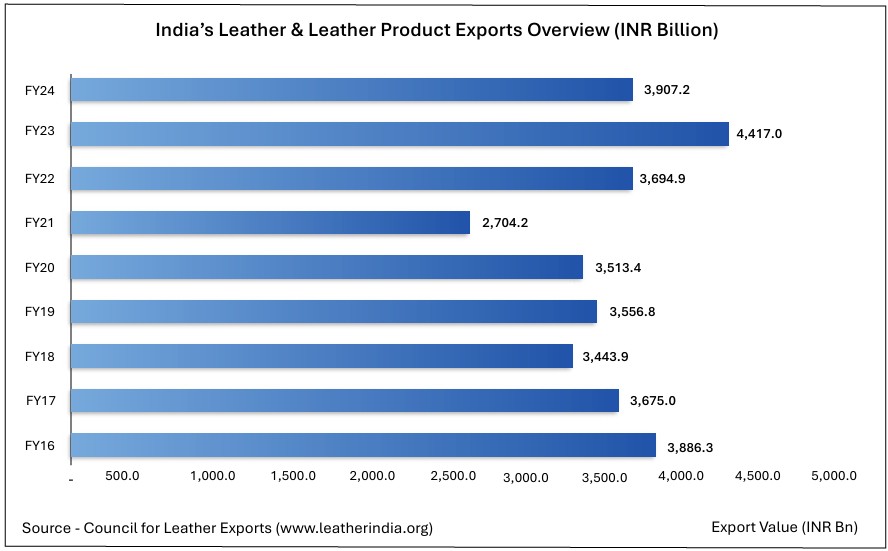
The Indian leather and footwear industry has shown resilience and recovery in recent years, supported by improving global demand and policy-led structural support. After the pandemic-induced slowdown, exports of leather and leather products increased from INR 2,704.2 billion in FY21 to INR 4,417 billion in FY23, before easing to INR 3,907.2 billion in FY24. This trend reflects recovery in key overseas markets such as the US and Europe, followed by normalization in global trade conditions.

Domestically, the industry is benefiting from strong consumption trends driven by urbanization, rising incomes and growing penetration of organized retail and e-commerce. India’s e-commerce sector, estimated at INR 10.8 trillion in 2024, is expected to reach INR 29.9 trillion by 2030, growing at a Compound Annual Growth Rate (CAGR) of 15%. Consumer preferences are steadily shifting toward branded, premium and lifestyle footwear, expanding demand across metro and non-metro markets. Digital platforms have further enhanced market access for manufacturers and brands, improving distribution efficiency and consumer reach.
India’s Leather & Footwear Industry by Product

Finished Leather

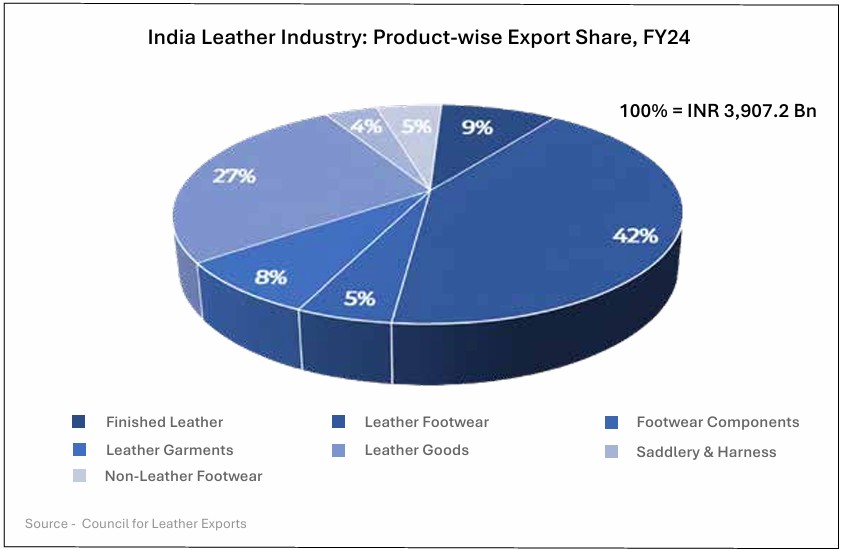
  • Finished leather accounts for roughly 9.2% to 9.5% of India’s total leather and footwear export basket.
  • India accounts for a share of 5.1% in the global finished leather imports.
  • India holds 12.5% of the world’s bovine hides & skins, 12.3% of goat & kid skins and 3.5% of sheep & lamb skins, ensuring a strong domestic supply base.
  • The country has around 2,091 tanneries, with 45% in Tamil Nadu, 26% in West Bengal, and 18% in Uttar Pradesh, supporting regional manufacturing clusters efficiently.

Leather Footwear

  • Leather footwear accounts for about 42% of India’s total leather and footwear exports.
  • To promote leather footwear manufacturing, the excise duty has been cut from 12% to 6%. This applies to footwear priced between INR 500 and INR 1,000, encouraging production and affordability.
  • During April–March 2024-25, India’s export of leather footwear reached USD 2,007.8 million (INR 166.9 billion), slightly up from USD 2,002.4 million (INR 164.8 billion) in April–March 2023-24.

Footwear Components

  • Footwear components account for 5% of India’s total leather and footwear exports.
  • It includes uppers, soles (rubber, PVC, leather), linings, insoles, heels and accessories, with major production hubs in Tamil Nadu (Chennai, Ambur), UP (Agra, Kanpur), & West Bengal (Kolkata).
  • The Indian tanning industry supplies over 2 billion square feet of leather per annum.

Leather Goods

  • Leather goods account for 27% of India’s total leather and footwear exports.
  • This sector produces a wide range of products, including bags and handbags, hand and industrial gloves, wallets, rucksacks, folios, briefcases, travel ware, belts, sports goods, upholstery items and saddlery products.
  • These products are designed to meet the requirements of bulk buyers and consumers in Europe, the USA and Australia.

Leather Garments

  • Leather garments account for 8% of India’s total leather and footwear exports.
  • India is the 2nd largest exporter of leather garments, after China.
  • Exports to major markets such as the EU, UK and the Middle East contribute significantly to this segment’s performance.

Saddlery & Harness

  • Saddlery & harness accounts for 8% of India’s total leather and footwear exports.
  • These products are valued for quality craftsmanship and durability, which help Indian exporters win business in discerning markets like Europe and North America.
  • India is the 3rd largest exporter of Saddlery & Harness, behind China and Germany.

No Leather Footwear

  • The full exemption from Basic Customs Duty on key raw materials such as wet blue leather has supported greater domestic value addition and improved export competitiveness.
  • Tamil Nadu is emerging as a non-leather hub, attracting Taiwanese firms and suppliers for major brands due to the China+1 strategy, creating jobs.

Government Initiatives

Indian Footwear and Leather Development Programme (IFLDP)

On March 3, 2022, the central government approved the Indian Footwear and Leather Development Programme (IFLDP), allocating INR 1,700 crore (INR 17 billion) for implementation up to March 31, 2026, or until further review, whichever comes earlier.

The seven sub-schemes under this programme include

  • Sustainable Technology and Environmental Promotion:
    • Supports the establishment of Common Effluent Treatment Plants (CETPs) to promote environmentally sustainable leather manufacturing across clusters.
    • Government assistance covers 80% of the project cost in Northeastern states and 70% in other regions, with support capped at INR 200 crore (INR 2 billion) per project.
  • Integrated Development of Leather Sector (IDLS):
    • Encourages modernization, capacity expansion and technology upgradation of leather sector units to improve productivity and competitiveness.
    • MSMEs receive 30% support (40% in Northeast), while non-MSME units receive 20% support (30% in Northeast) on plant and machinery costs.
  • Mega Leather Footwear and Accessories Cluster Development (MLFACD):
    • Aims to create world-class leather and footwear clusters integrating the full production value chain for domestic and export markets.
    • Provides 50% project cost support (70% in Northeast) for infrastructure and facilities, excluding land, with a maximum cap of INR 125 crore (INR 1,250 million).
  • Development of Design Studios:
    • Establishes 10 Indian design studios to drive design innovation, technology adoption and market responsiveness.
    • Acts as a one-stop hub for design support, buyer-seller meets, quality control, export linkage and trade fair participation.
  • Procedure for implementation of Vision document component under STEP sub-scheme of IFLDP:
    • Aims to develop a long-term vision document addressing raw material supply, demand trends, policy direction and societal relevance.
    • Implementation & funding – Prepared by the Development Council for Footwear & Leather Industry with 100% Government of India funding, capped at INR 5 crore (INR 50 million) as a one-time grant.
  • Establishment of Institutional Facilities:
    • Focuses on creating and upgrading infrastructure at existing FDDI campuses to strengthen skill development and training.
    • Includes International Testing Centres, sports complexes, girls’ hostels and other academic and support infrastructure.
  • Brand Promotion of Indian Brands in the Leather and Footwear Sector:
    • Supports promotion of Indian leather and footwear brands in global markets to enhance export visibility.
    • Government funds 50% of project cost, capped at INR 3 crore (INR 30 million) per brand per year, for eligible firms with INR 50 crore (INR 500 million) annual sales.

Megatrends in the Leather & Footwear Industry

Increasing Shift Towards Sustainability

  • Rising consumer preference for ethical, cruelty-free and sustainable products is driving a shift toward vegan leather alternatives.
  • There is a growing market for high-quality leather bags and related products made from sustainable and eco-friendly materials. Top Indian start-ups include Phool, Banofi Leather, Malai and PA Footwear Pvt Ltd.
  • India’s synthetic leather market reached INR 3,139.6 million in 2024 and is forecast to expand to INR 4,534.9 million by 2033, registering a compound annual growth rate of 4.0% between 2025 and 2033.

Major Policy Support

  • Announced in the 2025 Union Budget, the Focus Product Scheme for Footwear and Leather Sectors targets a turnover of INR 4 lakh crore (INR 4 trillion) and aims to create 22 lakh jobs.
  • It specifically supports design capacity and the manufacturing of components for non-leather footwear.
  • To boost exports in the footwear and leather sectors, the finance minister announced in February 2025 that the Centre will establish an Export Promotion Mission.

Why Invest in India’s Leather & Footwear Industry?

High Availability of Raw Materials

  • India has a strong domestic raw material base, producing approximately 3 billion square feet of leather each year.
  • India is endowed with a large share of global raw materials, including approximately 20% of the world’s cattle and buffalo population and about 11% of the world’s goat & sheep population.

Growing Market Value & Premiumization Trends

  • India’s footwear market continues strong growth, supported by rising disposable incomes and expanding organized retail and e-commerce platforms.
  • India’s e-commerce market is projected to reach INR 29.9 trillion in Gross Merchandise Value (GMV) by 2030, driven by rapid digital adoption.
  • There is an increased shift toward premium, branded and lifestyle footwear.

Robust Export Demand

  • India is expanding its global export footprint, with strong growth in traditional markets (EU, US) and emerging markets (Middle East, Africa).
  • Of the nearly 16 billion pairs of footwear produced each year globally, India manufactures around 2,065 million pairs across various footwear categories.
  • The top 15 countries together accounted for about 77.8% of India’s total exports of leather, leather products and footwear during April–March 2023–24.

Our Team

Meet Our Experts

Download PDF