
Read Time: 5 min

Market Reports

India’s Space & Satellite Industry

Market Report - India’s Space & Satellite Industry

Why India’s Space & Satellite Industry is Gaining Global Attention?

India’s space and satellite market is rapidly emerging as one of the most dynamic segments of the global space economy. The Indian commercial space market is transitioning from a government-led model to a private-driven ecosystem, supported by policy reforms and rising investment in India space sector. Traditionally dominated by public missions, the Indian space industry valuation is now expanding due to increased private participation and global demand for cost-efficient solutions. In parallel, strong global satellite industry growth and the expanding global satellite services market are creating significant opportunities for India to strengthen its global positioning. India’s reputation for low-cost, high-reliability space missions, led by the Indian Space Research Organization, has positioned it as a preferred partner for satellite launches and space services. With the global space economy projected to exceed USD 1 trillion (INR 85 trillion) by 2040, India aims to significantly expand its share through innovation, commercialization and international collaboration.

What are the Key Facts About India’s Space & Satellite Industry?

  • According to the Indian government, the Indian space industry valuation stood at approximately INR 697 billion as of October 2024, accounting for about 2% of the global space market, reflecting the steady growth of the satellite market in India and increasing global competitiveness.
  • The future of India’s space industry remains highly promising, with the country aiming to scale the market to INR 3,652 billion by 2033, including nearly INR 913 billion in exports, which would increase its global share to around 7–8%, significantly strengthening its position in the Indian space and satellite market.
  • This growth is supported by a growing ecosystem of 399 startups, reflecting key trends in India space industry, including innovation in launch vehicles, satellite manufacturing, propulsion technologies, and space-grade electronics.
  • In April 2026, V. Narayanan, Chairman of ISRO, announced that the G20 satellite, which is aimed at studying climate change, air pollution and weather patterns, is scheduled for launch in 2027.
  • Of the 434 foreign satellites launched by ISRO so far, 399 have been launched since 2014. These missions have generated revenues of approximately Euro 323 million (INR 29.1 billion) and USD 233 million (INR 19.3 billion), highlighting India’s growing presence in the global space launch market.

What is Driving the Expansion of India’s Space & Satellite Market?

Government Policy Reforms

  • The establishment of the Indian National Space Promotion and Authorisation Centre (IN-SPACe), serving as a single-window interface that facilitates collaboration between private industry and government agencies, including the Indian Space Research Organisation (ISRO).
  • To support this growth, the Indian government has significantly increased the space budget by 144%, rising from INR 56.1 billion in FY2014 to INR 137 billion in FY2026.

Rising Demand for Satellite-Based Services
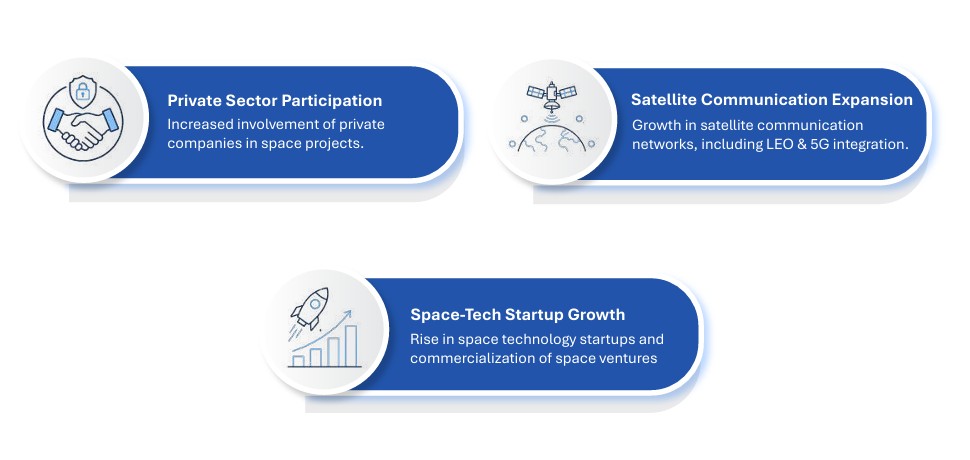
  • The demand for satellite services in India is witnessing rapid growth, with the satellite data services market valued at USD 495 million (INR 46 billion) in 2024, driven by increasing adoption across defence, climate monitoring, logistics and urban planning.
  • This rising demand aligns with expansion in the global satellite services market, positioning India as a key contributor to global data-driven space applications.
  • India is increasingly shifting toward LEO (Low Earth Orbit) and MEO (Medium Earth Orbit) satellite-based internet services to enable faster and more reliable broadband connectivity across the country.
  • More than 10 satellite operators, including licensed players such as Starlink, have entered the market, supported by policies allowing up to 100% FDI in the private sector. These reforms are attracting global companies in India space market, strengthening international collaboration, and boosting investment in India space sector.

What are the Key Government Initiatives Shaping India?

  • Aligned with India’s Space Vision 2047, the government has outlined ambitious goals, including establishing the Bharatiya Antariksh Station by 2035 and undertaking the country’s first crewed lunar mission by 2040.
  • The government has approved five major projects to advance these goals:
    1. The Gaganyaan follow-on mission to support the development of the first module of the Bharatiya Antariksh Station
    2. The Chandrayaan-4 lunar sample return mission
    3. The Chandrayaan-5/LUPEX (Lunar Polar Exploration) mission
    4. The Venus Orbiter Mission
    5. The development of a Next Generation Launch Vehicle.
  • These initiatives clearly define the future of India’s space industry, positioning the country as a major global space power.

How Can Investors and Global Companies Enter India’s Space Market

Future Outlook of India Space & Satellite Industry

The Indian space and satellite market is rapidly evolving from a state-led scientific ecosystem into an INR 3,652 billion commercial powerhouse by 2033. This transformation is driven by strong India space sector growth factors, including FDI liberalization, private sector participation, and policy support through IN-SPACe. The maturation of this ecosystem is evident in the milestones achieved by startups like Skyroot Aerospace and Agnikul Cosmos, which have shown high-precision launch capabilities.  This increasing presence of startups and global companies in India’s space market highlights India’s integration into the global aerospace value chain. With the strong growth of the satellite market in India and a focus on cost-efficient launch capabilities, the country is well-positioned to benefit from ongoing global satellite industry growth. Ultimately, the future of India’s space industry lies in its ability to scale innovation, expand satellite-based services and become a global hub for space technology and data services.

Businesses can explore UJA Global Advisory for end-to-end support in India entry and compliance.

How UJA Supports Space & Satellite Businesses Entering India

UJA offers comprehensive advisory services tailored for Space & Satellite companies:

  • Market entry strategy and expansion planning
  • Regulatory and compliance advisory
  • Tax and transfer pricing services
  • M&A and joint venture support
  • Accounting, audit and risk advisory

With 30+ years of experience and global presence (India, Japan, Europe), UJA enables seamless cross-border expansion.

Frequently Ask Questions

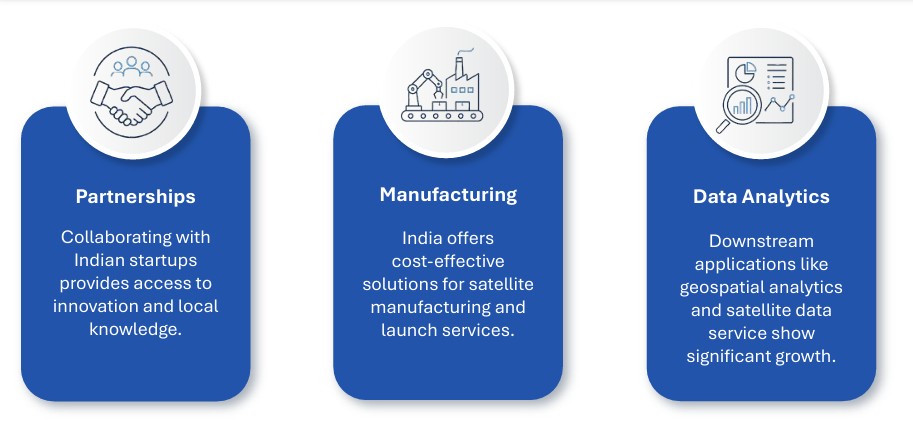
It includes satellite manufacturing, launch services, and downstream applications such as data analytics and communication, forming the core of the Indian commercial space market.

In October 2024, India’s space economy was valued at approximately INR 697 billion, with strong growth potential.

Satellite demand, defense applications and commercialization of space technologies.

Yes, India allows significant FDI in the space sector under government regulations.

India aims to become a major contributor to the global space economy, targeting INR 3,652 billion by 2033.

Looking to explore opportunities in the Indian Space & Satellite Market or expand your business in India? Partner with UJA Global Advisory for end-to-end support across market entry, regulatory compliance and strategic growth, ensuring a smooth and successful expansion journey.

Our Team

Meet Our Experts

Download PDF