
Read Time: 5 min

Market Reports

India’s Specialty Chemicals Industry

india-specialty-chemicals-industry

What are Specialty Chemicals?

Specialty chemicals are high-value, performance-driven chemicals that are manufactured for specific applications or end-use requirements rather than being produced mainly based on volume or basic chemical composition. With rising domestic and global demand from key industries such as electronics, automotive, construction, aerospace, food and pharmaceuticals, and the global shift toward sustainable practices and decarbonisation, the demand for specialty chemicals is witnessing significant growth. The India specialty chemicals industry constitutes approximately 47% of the country’s domestic chemical market and is expected to grow at a CAGR of nearly 11% over the next five years. Additionally, in Chemicals industry, 100% FDI in India is allowed under the automatic route (except in the case of certain hazardous chemicals).

India Specialty Chemicals Industry: Why Global Companies are Expanding into India?

  • India’s chemical industry, which was estimated to be worth around INR 21.5 trillion in 2024, is anticipated to grow to INR 28.4 billion by 2028 and approximately INR 86 trillion by 2040. 
  • The Indian chemicals industry covers 80,000+ products and supports over 2 million jobs, highlighting the depth of the ecosystem.
  • India’s specialty chemical companies are expanding their production capacities to meet growing domestic and global demand.
  • In the specialty chemicals sector, manufacturers are increasingly focusing on sustainable solutions such as green solvents, biodegradable surfactants and bio-based polymers. India’s green chemicals market is projected to grow at a CAGR of over 10% and surpass USD 15 billion (~INR 1,420 billion) by 2027.
  • Agrochemicals, a key sub-segment of specialty chemicals, currently represent a ~USD 5.5 billion (~INR 520 billion) market in India.
  • The segment is expected to witness strong growth and is projected to contribute nearly 40% of India’s total chemical exports by 2040.
  • Global companies are increasingly diversifying chemical supply chains beyond China due to rising manufacturing costs, geopolitical risks and supply chain disruptions.
  • India offers 100% FDI permitted under the automatic route in the chemicals sector.

Why is the India Specialty Chemicals Market Growing

Rising Domestic Consumption

  • Chemicals serve as a critical input across key end-use industries, including agriculture, pharmaceuticals, automotive, electronics, construction and more.
  • Nearly 70% of India’s chemical production is consumed domestically, highlighting strong internal demand.
  • India is expected to contribute 20% of incremental global chemical consumption over the next two decades.
  • Domestic chemical demand is projected to reach INR 70,550–84,000 billion by 2040, driven by industrial growth and consumption trends.

Increasing Government Support and Foreign Investments

  • The Indian government is planning to introduce a National Chemical Policy aimed at strengthening the sector and enabling it to contribute 6% to India’s GDP over the next decade.
  • The implementation of targeted Product Linked Incentive (PLI) schemes and increased budgetary allocations through Union Budgets have further accelerated growth and investment in the chemical industry.

Government Initiatives Supporting the Specialty Chemicals Industry in India

Petroleum, Chemicals and Petrochemical Investment Regions (PCPIRs)

  • A petroleum, chemicals and petrochemical investment region (PCPIR) is a specific investment region designed for domestic and export-led chemical and petrochemical manufacturing.
  • The government aims to position India as a global hub for the petroleum, chemicals and petrochemicals sector by attracting domestic and foreign investments through a transparent, investor-friendly policy framework and enabling the development of integrated PCPIRs.
  • At present, three PCPIRs have been designed in the States of Andhra Pradesh (Vishakhapatnam), Gujarat (Dahej) and Odisha (Paradeep).

Chemical Parks

  • Union Budget 2026–27 introduces a new scheme to support States in developing three dedicated Chemical Parks through a challenge-based approach.
  • The parks will adopt a cluster-based, plug-and-play model with shared infrastructure and common environmental compliance facilities.
  • An allocation of INR 600 crore has been provided in BE FY 2026–27 to support the development of these Chemical Parks.

Emerging Opportunities Across Key Specialty Chemical Segments

Shift toward Green Chemistry and Sustainability

  • Manufacturers are increasingly focusing on developing bio-based, biodegradable, and low-carbon specialty chemicals to reduce environmental impact and meet stringent regulatory requirements.
  • For instance, companies are investing in sustainable alternatives such as bio-based solvents and eco-friendly additives to support decarbonisation goals.
  • In April 2026, MilliporeSigma launched the industry’s first bio-based HPLC solvent portfolio, offering drop-in alternatives to acetonitrile, methanol and ethanol that reduce CO₂e emissions by up to 29% without requiring method redevelopment.

 Expansion into High-Growth Application Areas
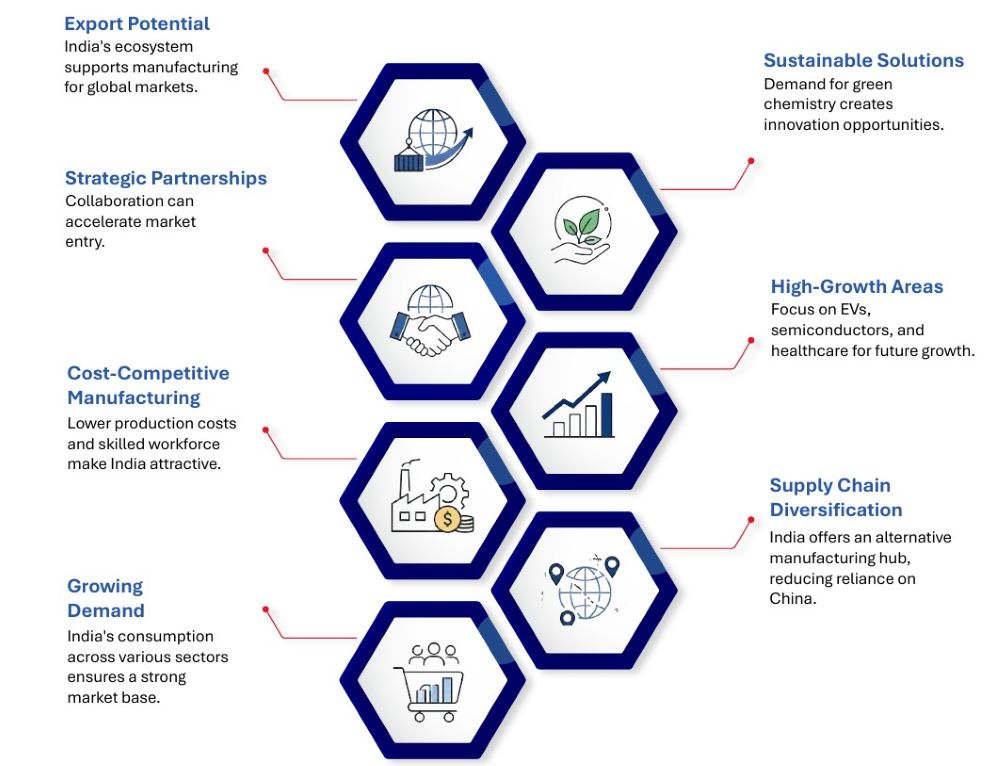
  • Increasing demand from emerging sectors such as renewable energy, electric vehicles (EVs), advanced electronics and healthcare is creating new growth opportunities.
  • For instance, specialty chemicals play a critical role in battery materials, semiconductor manufacturing chemicals and advanced polymers used in next-generation technologies.

Opportunities for Foreign Companies Entering India's Specialty Chemicals Market

Future Outlook of India Specialty Chemicals Industry

The Indian specialty & fine chemicals market is projected to grow at a CAGR of ~9.3% between 2023 and 2030, driven by increasing manufacturing capabilities and export opportunities. India’s vision for 2030 is to emerge as a global chemical manufacturing hub, capturing 5–6% of the global chemical value chain. To achieve this, the sector aims to double its current production capacity while significantly reducing the trade deficit of USD 31 billion (INR 2,928 billion) recorded in 2023, with the long-term goal of achieving a balanced trade position. India’s specialty chemicals industry is poised for sustainable, innovation-led global growth.

Businesses that leverage strategic advisory and compliance expertise will be well-positioned to capitalise on this evolving market and achieve long-term success.

Businesses can explore UJA Global Advisory for end-to-end support in India entry and compliance.

How UJA Supports Specialty Chemicals Businesses Entering India

UJA offers comprehensive advisory services tailored for Specialty Chemicals companies:

  • Market entry strategy and expansion planning
  • Regulatory and compliance advisory
  • Tax and transfer pricing services.
  • M&A and joint venture support
  • Accounting, audit and risk advisory

With 30+ years of experience and global presence (India, Japan, Europe), UJA enables seamless cross-border expansion.

Frequently Ask Questions

It includes chemicals developed for specific applications across industries such as pharma, agriculture, automotive, and electronics.

They improve product quality, support innovation, and enable advanced manufacturing across key sectors.

Growing industrial demand, sustainability trends, exports, and increasing manufacturing activities drive market growth.

Through partnerships, joint ventures, acquisitions, or local manufacturing setups.

Yes, due to strong demand growth, cost advantages, and expanding industrial opportunities.

Sustainability trends are driving demand for green chemistry, bio-based chemicals, low-carbon solutions, and environmentally friendly manufacturing processes.

Looking to explore opportunities in the India Specialty Chemicals Market or expand your business in India? Partner with UJA Global Advisory for end-to-end support across market entry, regulatory compliance, and strategic growth, ensuring a smooth and successful expansion journey.

Our Team

Meet Our Experts

Download PDF