
Every year, India pays foreign suppliers for goods it has the demand, talent and land to make at home. In FY 2025-26, merchandise imports reached about $776 billion, a record. Inside that figure sits a shortlist overseas factory owners should read closely: 1,272 products worth nearly $189 billion in annual imports that India now wants to manufacture domestically. For anyone studying India import substitution, this is no longer a slogan. It is a buying list with product names attached.
The Centre-state strategy picks products that each record more than $50 million in yearly imports and are either not made in India or made in inadequate quantities. It also draws a sober line: only about 26% of the import basket can realistically be replaced. Crude oil, gold and coal will stay imported. Another 28% are already competitive at home, so those purchases reflect price or quality choices rather than missing factories.
Only a quarter of India’s import bill can realistically be replaced
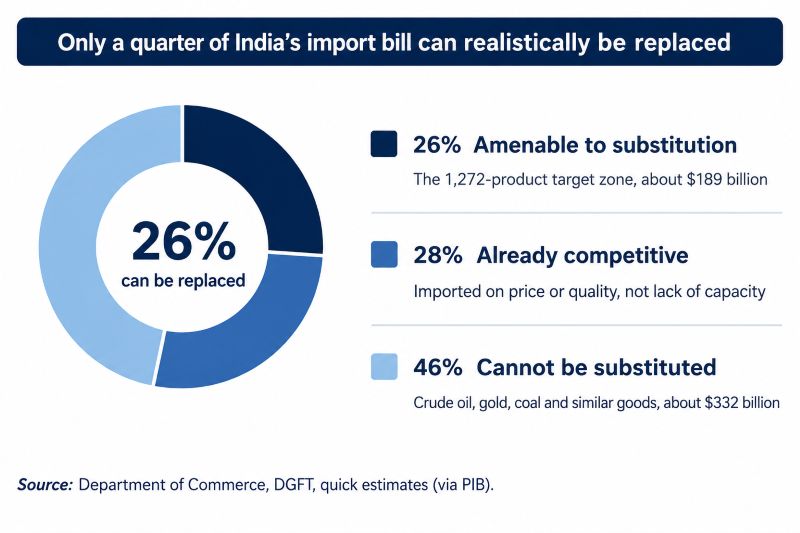
Source: Centre’s assessment of the FY 2025-26 import basket, as set out in the Centre-state import-substitution strategy.
That leaves the 26% slice as the real prize. It is specific, it is large, and it is where foreign manufacturers in India can fill gaps instead of fighting established local players.
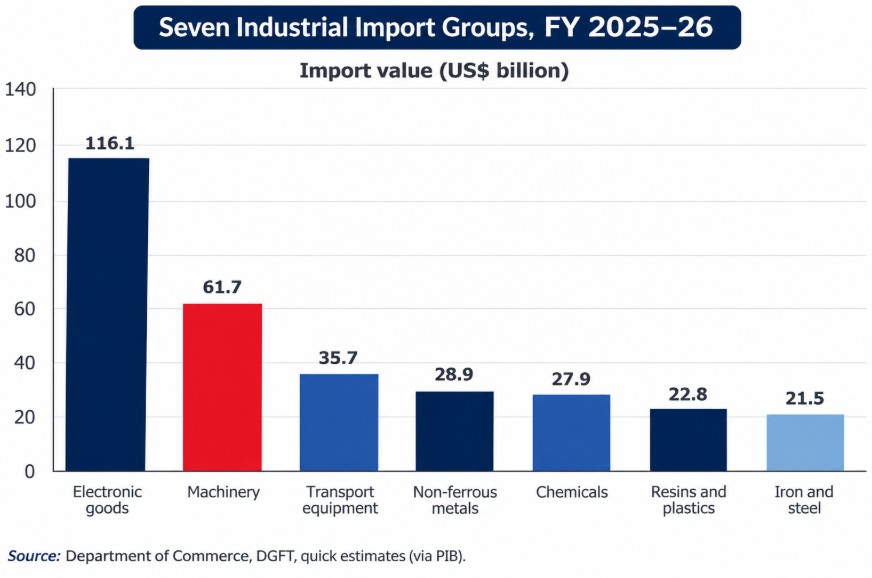
Department of Commerce data for FY 2025-26 shows how concentrated the opportunity is. Electronic goods alone cost $116.1 billion, and machinery another $61.7 billion. Add transport equipment, non-ferrous metals, chemicals, plastics and steel, and these seven industrial groups pass $300 billion. They pair heavy demand with thin domestic supply, which is the combination that creates India manufacturing opportunities.
Seven industrial import groups, FY 2025-26 (US$ billion)
The strategy names chemicals, electronics, machinery and specialty steel as focus areas. Here is how each looks to an investor.
Electronics Components and sub-assemblies | Imports rose 17.6% in FY 2025-26. Component, display and sensor specialists can serve assemblers who still import most sub-assemblies. |
Machinery Machine tools and automation | Machine tool imports reached $6.5 billion, up 14.4%. Precision and tooling expertise is scarce locally, so technology-led entrants hold an edge. |
Chemicals Specialty chemicals and resins | Chemicals and plastic materials together cost $50.7 billion in imports. Process know-how is the gating factor, and foreign partners bring it. |
Metals Specialty steel and alloys | Non-ferrous metal imports grew 17.1% to $28.9 billion, with iron and steel at $21.5 billion. Alloy producers can serve auto, defence and capital goods buyers. |
ILLUSTRATIVE SCENARIO
Picture a mid-sized European maker of printed circuit boards and connectors. Its Indian customers assemble phones, appliances and industrial controls, yet import the boards. A plant near an existing electronics cluster cuts lead times and import exposure. The government’s Production Linked Incentive schemes, announced for 14 sectors with an outlay of ₹1.97 lakh crore, improve the economics further. For the chip side of this story, read UJA’s note on India’s semiconductor revolution.
India recorded a historic $94.53 billion in FDI during 2025-26, with over 90% of equity inflows through the automatic route, according to DPIIT. The Centre has also asked states to create sector-specific clusters, single-window clearances and fiscal support, since states control land and approvals. Together, these make India investment opportunities easier to act on than a policy announcement alone.
Supply chains matter too. Many listed products need a full supporting chain of inputs, tooling, testing and logistics. Each missing link is a niche, and India supply chain opportunities favour suppliers who follow their anchor customers into the country.
Domestic production only works when cost and quality come close to global levels. Support schemes should help a plant cross its early cost barrier, not cover weak productivity forever. Manufacturers that plan to export from day one, and not only sell locally, are better placed.
Start with manufacturing market research India teams can trust:
Doing this before committing capital turns a headline number into a plan. Industrial manufacturing in India rewards firms that localise sourcing early.
UJA’s market-entry team helps foreign manufactures test demand, structure the entity and set up operations. Book a free 15-minute consultation & find out where your products fir.
Book a Free Consultation -> www.uja.in/contact-us