
India is no longer just a consumer of chips — it is fast becoming a serious player in their design and manufacturing. Over the past few years, the India Semiconductor Industry has moved from policy announcements to steel-and-concrete reality, with fabrication units, packaging plants, and design centres coming up across the country. For global investors, component makers, and ancillary businesses, this shift is opening up one of the most significant industrial opportunities of the decade.
At the heart of this transformation is the India Semiconductor Mission (ISM), a government programme run by the Ministry of Electronics and Information Technology (MeitY) to build a complete semiconductor and display ecosystem in the country. What started as an ambitious policy has now translated into 12 approved projects spanning fabrication, compound semiconductors, and assembly-testing-marking-packaging (ATMP/OSAT) facilities, with a cumulative investment of around ₹1.64 lakh crore.
The government has since launched ISM 2.0, with an outlay of ₹1,27,500 crore, aimed at deepening the ecosystem further — advanced-node R&D, semiconductor equipment and materials manufacturing & indigenous IP development. Speaking at SEMICON India 2026 in New Delhi, the Prime Minister highlighted the scale of this ambition, noting that the mission now represents a $13.5 billion national commitment to chip-making.
The last two years have seen semiconductor investments in India move from paper approvals to operational plants:
Here is how the approved projects are currently distributed across states:
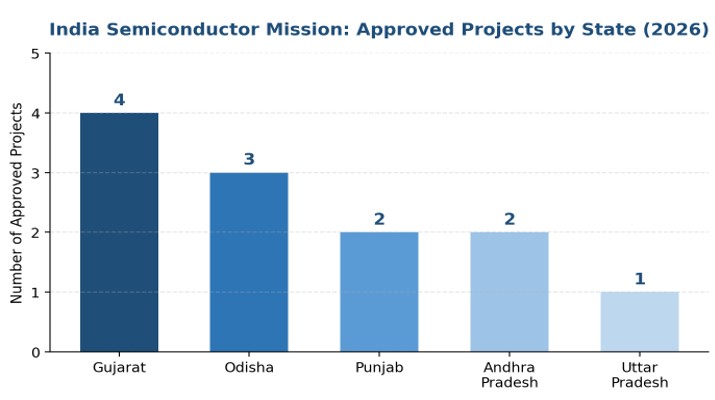
Gujarat alone hosts four projects, three of them in Sanand, which has quickly established itself as India’s first true ATMP hub.
What makes India semiconductor manufacturing noteworthy is that it isn’t limited to one segment of the value chain. The 12 approved projects cover:
This spread matters because it means India is building capability across design, fabrication, and packaging simultaneously — rather than just being an assembly hub. The government has indicated that India’s first major silicon fab is on track for commissioning around 2028, while packaging and testing capacity is already coming online.
For businesses, the ripple effects go well beyond the chip plants themselves. Semiconductor business opportunities are emerging across:
Take the automotive electronics industry as a working example. As Indian and global automakers accelerate EV and ADAS (advanced driver-assistance systems) production, they need a steady, tariff-secure supply of power-management chips, sensors & memory modules. With Micron’s Sanand facility producing DRAM and NAND for automotive applications, and compound semiconductor lines coming up for display and lighting components, auto component manufacturers now have a genuine case for sourcing chips domestically instead of relying entirely on imports from Taiwan or South Korea, cutting lead times and currency exposure in the process.
For international companies evaluating an entry into this space, whether as a fab partner, an equipment supplier, or a downstream manufacturer, getting the structuring, compliance, and regulatory approvals right from day one is critical. This is exactly where firms like UJA support investors: from company incorporation and FDI compliance to tax structuring for units set up under ISM incentive schemes.
For the official, up-to-date status of approved projects and incentive frameworks, the Prime Minister’s Office press release on ISM approvals is a reliable government source to track.
The India Semiconductor Mission is a government programme run by MeitY to build a complete semiconductor and display ecosystem in India, covering fabrication, compound semiconductors, packaging and testing, and design. It offers fiscal incentives to companies setting up manufacturing units in the country.
As of 2026, the government has approved 12 semiconductors and display projects under ISM with a cumulative investment of around ₹1.64 lakh crore. ISM 2.0 adds a further outlay of ₹1,27,500 crore to deepen the ecosystem.
India’s first large-scale commercial fab, being built by Tata Electronics with Taiwan’s PSMC in Dholera, Gujarat, is on track for commissioning around 2028. Several ATMP and packaging units, such as Micron’s Sanand facility, are already operational.
Gujarat currently leads with four approved projects, largely concentrated around Sanand and Dholera. Odisha, Punjab, Andhra Pradesh, and Uttar Pradesh have also secured approved projects under the mission.
Foreign companies can enter as fab partners, equipment and materials suppliers, design-service providers, or downstream users of locally made chips. Setting up typically involves company incorporation, FDI compliance, and structuring to access ISM incentives — areas where advisory firms such as UJA assist investors.
India’s semiconductor story is still in its early chapters — the first major fab won’t be commissioned until 2028, but the direction is unmistakable. With sustained government backing, rising global investor confidence and a widening base of ancillary industries, India is positioning itself as a credible alternative in the global chip supply chain, not just a market for finished electronics.
Looking to set up or expand your business in India’s semiconductor ecosystem? Get in touch with UJA’s advisory team for end-to-end support on entity setup, regulatory approvals, and tax structuring tailored to the semiconductor and electronics sector. Visit www.uja.in to schedule a consultation today.