

Read Time: 5 min

Market Reports

India’s Aviation Industry

India’s Aviation Industry

Quick Facts: India’s Aviation Industry

  • India is the world’s third-largest domestic aviation market, with the number of operational airports rising from 74 in 2014 to 163 in 2025
  • The aviation sector is among the fastest-growing segments of India’s economy, driving growth not only through air transport services but also by supporting tourism, trade, logistics and manufacturing
  • The aviation sector supports over 7.7 million jobs indirectly, including approximately 369,000 direct positions
  • By 2040, passenger traffic is projected to grow nearly six-fold, reaching approximately 1.1 billion
  • India’s commercial airline fleet is expected to expand from 800 aircraft in 2024 to around 2,300 by March 2040
  • Aligned with the Viksit Bharat vision of 350+ airports by 2047, Airports Authority of India (AAI) is rapidly expanding its training ecosystem to support India’s aviation growth
  • Initiatives such as AAI-AVSAR (Airport as Venue for Skilled Artisans of the Region) promote inclusive regional development by empowering local artisans and self-help groups, while positioning airports as hubs for investment and enhanced connectivity

Overview of the Indian Aviation Industry

The Indian civil aviation sector is among the fastest-growing in the world and aspires to become the largest by 2030. The aviation market is projected to expand from approximately USD 30 billion (INR 2,721 billion) today to nearly USD 1 trillion (INR 90.6 trillion) by 2047. To meet rising demand, India is developing new airports and expanding existing ones through the Public–Private Partnership (PPP) model.

Growth is being driven by the expansion of Low-Cost Carriers (LCCs), modernization of airport infrastructure, 100% Foreign Direct Investment (FDI) in scheduled airlines, advanced IT integration and a strong focus on regional connectivity. For instance, India’s MRO market is projected to reach INR 340 billion by 2031, supported by policy reforms including 100% FDI and a uniform 5% IGST on aircraft parts and components. Among airlines, IndiGo maintains its leadership with the largest market share, backed by a robust fleet and a wide domestic and international network.
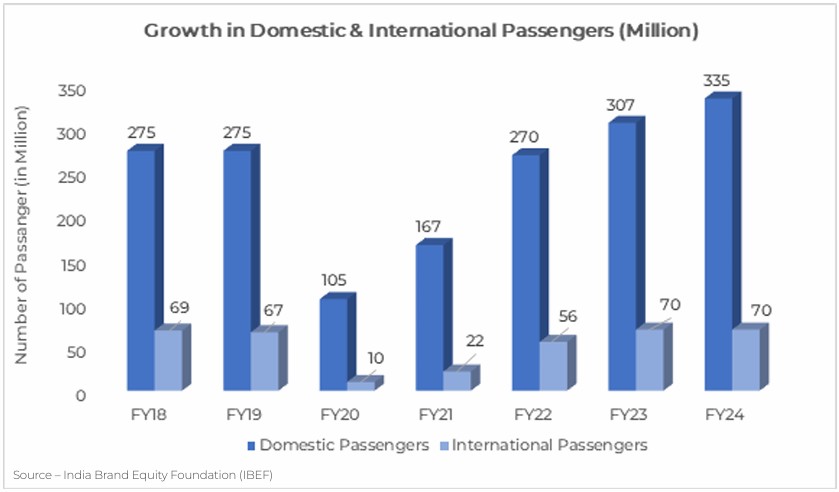
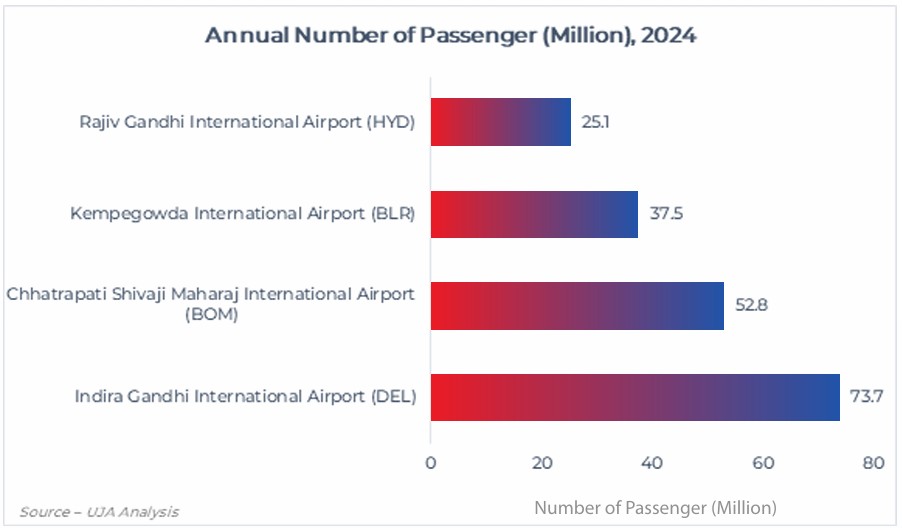
India’s Aviation Industry: Major Airports

Indira Gandhi International Airport (DEL) – Delhi

  • India’s busiest airport, handling the highest overall passenger traffic. Spread over 5,106 acres, it serves the National Capital Region with three main terminals (T1, T2, T3) handling domestic and international flights.
  • Major international gateway with extensive long-haul connectivity (North America, Europe, Middle East).
  • Primary hub for Air India and IndiGo, driving both domestic and transit traffic.

Chhatrapati Shivaji Maharaj International Airport CSMIA, (BOM) – Mumbai

  • CSMIA, with a legacy spanning over 90 years, covers approximately 1,900 acres and ranks as India’s second busiest airport by passenger traffic, handling 55.1 million passengers in FY 2024–25.
  • In December 2024, CSMIA became the first airport in India and the third globally to receive Level 5 Accreditation for Airport Customer Experience from Airports Council International (ACI).
  • Slot-constrained airport, leading to capacity optimization and high aircraft utilization.

Kempegowda International Airport (BLR) – Bengaluru

  • The airport holds the unique distinction of being India’s first greenfield airport developed under a Public-Private Partnership (PPP) model.
  • It provides non-stop connectivity to 76 domestic and 33 international destinations, with Hanoi set to become the 34th international destination from early May 2025.
  • On the cargo front, BLR Airport crossed the 500,000 Metric Tons (MT) milestone for the first time, handling a total of 502,480 MT of cargo in FY 2024–25.

Rajiv Gandhi International Airport (HYD) – Hyderabad
  • The airport spans approximately 5,500 acres, making it the largest airport in India by land area.
  • It is a major South India gateway serving 100+ destinations, with a single integrated terminal, a 4.2-km runway and advanced passenger technologies including AI-driven robots.
  • In September 2024, the airport launched a dedicated General Aviation Terminal exclusively for private jet owners and charter passengers, catering to both business and personal travel needs.

Government Initiatives

UDAN (Affordable Regional Air Travel)

  • Launched by Prime Minister Shri Narendra Modi on October 21, 2016, the Regional Connectivity Scheme (RCS) – UDAN (“Ude Desh ka Aam Nagrik”) aims to democratize aviation by making flying accessible and affordable for all.
  • Between 2016 and 2025, the UDAN scheme achieved significant milestones in strengthening regional air connectivity across India.
  • About 625 routes have been operationalized, connecting 90 airports, including 15 heliports and 2 water aerodromes.
  • The airport network expanded substantially, increasing from 74 airports in 2014 to 159 in 2024.

Greenfield Airports (Infrastructure Expansion Initiative)

  • The Airports Authority of India (AAI) has proposed a capital expenditure plan of INR 250 billion for the period FY 2024–25 to FY 2028–29, along with the assessment of more than 400 airstrips and capacity expansion initiatives at major hubs and regional airports.
  • As of February 2026, 93 airports operated by the AAI have achieved 100% green energy usage through the installation of on-site solar Photovoltaic (PV) systems.
  • Through its subsidiary AAI Cargo Logistics & Allied Services Company Limited (AAICLAS), AAI is enhancing cargo capacity in Tier-II and Tier-III cities by upgrading facilities, including cold storage, at key regional airports.

Flying Training Organisation Expansion – Skill Development Initiative

  • According to the 2025 CAE Aviation Talent Forecast, India is projected to require approximately 22,000 commercial pilots by 2034.
  • Air India plans to train over 50,000 employees, including pilots, cabin crew, engineers and security staff, through its upcoming Training Academy in Gurugram.
  • Scheduled to open by 2026, the facility will be South Asia’s largest aviation training center, with the capacity to graduate 180 commercial pilots annually.
  • Air India is constructing a mega MRO facility in Bengaluru, which will be operational by 2026.

Megatrends in the Aviation Industry

Digitalization and Biometrics

  • Major airlines such as Air India and IndiGo, along with airports in Delhi, Mumbai and Hyderabad are integrating AI, cloud platforms, IoT and biometric technologies into their operations.
  • Initiatives like DigiYatra (with ~15 million users as of August 2025), AI chatbots handling around 30,000 daily queries and IoT-enabled smart baggage trolleys in Hyderabad highlight this shift.
  • These innovations, combined with cloud-based revenue management systems and advanced analytics, are enabling Indian carriers to enhance revenue optimization while reducing operational costs.

Infrastructure Build-Out and Regional Connectivity

  • The Government of India has committed to developing 50 new airports over the next five years, significantly enhancing regional connectivity and stimulating economic growth.
  • The Airports Authority of India (AAI) has allocated a capital outlay of approximately INR 34.9 billion for 2026–2028 to modernize Communication, Navigation and Surveillance/Air Traffic Management (CNS/ATM) infrastructure across airports nationwide.

Why Invest in the India’s Aviation Industry?

Growing Aviation Demand

  • In 2024, India’s domestic air passenger traffic grew by 6.1% to 161.3 million passengers, reflecting strong demand for air travel after the pandemic.
  • The Union Civil Aviation Minister stated that India’s total air passenger traffic is expected to reach 300 million annually by 2030, underlining a rapidly expanding aviation market.
  • In the fiscal year 2025, domestic airlines carried 43.2 million passengers, up 10.3% from the previous year, indicating robust long-term demand growth.

Airport Infrastructure Development

  • Six international airports have been completed under the Public–Private Partnership (PPP) model and the sector is projected to attract USD 25 billion (INR 2,266.6 billion) in investments by 2027.
  • In October 2025, the first phase of The Navi Mumbai International Airport was inaugurated, which is being developed under PPP by Mumbai International Airport Limited (a subsidiary of Adani Airports Holdings Ltd) in partnership with City and Industrial Development Corporation of Maharashtra, with an estimated investment of USD 2.2 billion (INR 201 billion).
  • Additionally, in December 2025, commercial operations commenced at the Noida International Airport (NIA) in Jewar, developed under a Public–Private Partnership (PPP) between the Government of Uttar Pradesh and Zurich Airport International AG.

Investment Friendly Policies

  • Effective July 15, 2024, the Indian government implemented a uniform 5% Integrated Goods and Services Tax (IGST) on all aircraft and aircraft engine parts, simplifying previous rates that ranged from 5% to 28%, indicating a major boost for the aviation sector.
  • 100% FDI is permitted via the automatic route for Maintenance, Repair and Overhaul (MRO) for aircraft, including engines and components.
  • For NRIs, 100% FDI is permitted under the automatic route in Scheduled Air Transport Services and Domestic Scheduled Passenger Airlines.


Our Team

Meet Our Experts

Download PDF