
Read Time: 5 min

Market Reports

India’s Luxury Beauty Industry

Market Report - India’s Luxury Beauty Industry

Quick Facts: India’s Luxury Beauty Industry

  • India is the fastest-growing luxury beauty market in Asia-Pacific after China, driven by rising disposable incomes and premiumization trends.
  • Global cosmetics leaders such as Shiseido, L’Oréal and Estée Lauder Companies are ramping up investments in India’s rapidly expanding luxury beauty sector, which is expected to grow nearly fivefold by 2035.
  • L’Oréal announced the world’s first beauty-tech hub in Hyderabad with an investment of INR 35 billion. It will focus on AI-driven skin diagnostics and digital tools tailored for Indian skin tones.
  • Several global luxury beauty brands, including Rare Beauty, Fenty Beauty, Huda Beauty and others, are entering the Indian market and expanding retail presence, reflecting growing demand.
  • Growth is driven by India’s young, affluent, and digitally savvy consumer base with rising disposable incomes and increased beauty awareness.
  • In 2025, India has 8,71,700 millionaire households (net worth ≥ INR 85 million), up 90% from 2021.
  • India has a Gen Z population of about 377 million, contributing nearly USD 930 billion in overall consumer spending. They are responsible for around 47% of fashion and lifestyle expenditure.

Overview of the Indian Luxury Beauty Industry

India’s per-person spending on beauty and personal care products is expected to grow from about USD 15 (INR 1250) in 2023 to nearly USD 27 by 2030. This growth is supported by higher incomes, faster urbanization, a large young population and increasing use of the internet and e-commerce. As a result, both affordable and premium beauty products are seeing stronger demand in metro as well as smaller cities.

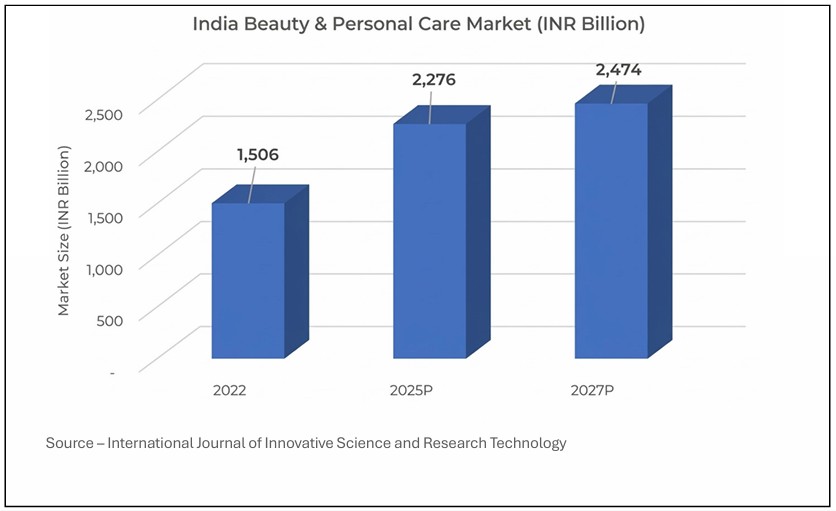
India’s luxury market is already substantial, generating revenues of USD 7.7 billion (INR 703.9 billion) in 2023 and expected to reach nearly USD 12 billion (INR 1,091.4 billion) by 2028. India’s luxury beauty industry is characterized by rapid premiumization, evolving consumer sophistication and strong omnichannel expansion. Rising urban incomes, exposure to global trends and increased spending on personal grooming have propelled demand for high-end skincare, cosmetics and fragrances. Between 2022 and 2027, India’s GDP is projected to expand at a CAGR of 8%, indicating a steady rise in overall economic activity and consumer purchasing power. Consumers are shifting from price-driven purchases to value-driven decisions focused on quality, efficacy and brand heritage.

The industry is supported by the expansion of luxury retail formats in premium malls, standalone boutiques and airport duty-free outlets, alongside strong digital penetration. Global brands are strengthening their presence through exclusive launches, influencer collaborations, and localized product strategies suited to Indian skin tones and climatic conditions.
India’s Luxury Beauty Industry: Top States

Maharashtra

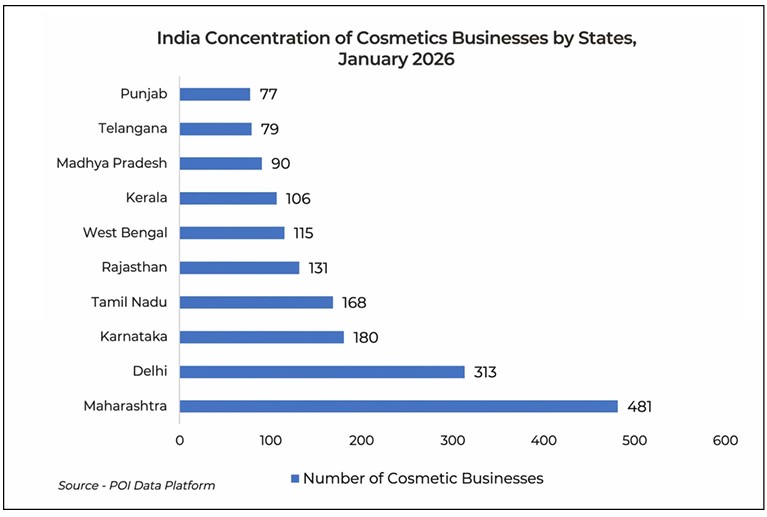
  • Maharashtra has the highest concentration of cosmetic industry units in India, indicating strong manufacturing and market infrastructure for beauty products.
  • Mumbai, as a hub for fashion and income, attracts luxury beauty launches and brand expansions. Luxury in India has evolved from heritage icons like The Taj Mahal Palace to modern integrated destinations such as Phoenix Palladium and The St. Regis Mumbai.
  • In November 2024, Reliance Retail’s beauty platform Tira opened its luxury flagship store at Jio World Plaza in Mumbai, aiming to elevate and redefine the premium beauty shopping experience in India.

Delhi

  • Delhi ranks among the top states for cosmetics industry presence, illustrating urban consumption and retailer density.
  • The capital’s affluent and cosmopolitan consumer base drives high demand for luxury beauty brands, both online and in premium retail.
  • The arrival of DLF Emporio and The Chanakya centralized global luxury in India, with malls designed using Italian marble and gold accents to resemble high-end galleries rather than traditional markets.

Karnataka

  • Karnataka has about 180 cosmetic industry units, ranking within the top states for beauty business presence.
  • Bangalore’s affluent population and high digital adoption create an expanding premium and luxury beauty consumer base.
  • Phoenix Mall of Asia houses large flagship stores of Nykaa Luxe and SSBeauty, offering “phygital” experiences with interactive screens that track movement and suggest makeup based on outfit colors.

Tamil Nadu

  • Tamil Nadu hosts a substantial beauty industry presence with 168 cosmetic units, indicating a moderate manufacturing foothold.
  • The Palladium at Phoenix Marketcity has a dedicated luxury wing, enabling brands like Jo Malone London and Kiehl’s to shift from small counters to spacious boutiques aligned with their global flagship designs.

Government Initiatives

Trade & Customs Duty Reforms

  • The Union Budget 2026–27 introduced a landmark change for the luxury sector to encourage discretionary spending.
  • The Basic Customs Duty (BCD) on goods imported for personal use (including high-end skincare and fragrances) was slashed from 20% to 10%.

The “AYUSH” Export Push

  • Through the Ministry of AYUSH, the government is funding R&D to provide clinical certification for Ayurvedic ingredients, helping Indian luxury brands meet EU and US standards.
  • Launched in late 2025, the SHE-MARTS Initiative program specifically supports women-led micro-enterprises in the premium organic and Ayurvedic space to access international luxury markets.

FDI and Single-Brand Retail Liberalization

  • The government has streamlined Foreign Direct Investment (FDI) rules to make it easier for luxury houses to operate without local middlemen.
  • Foreign luxury brands can now own 100% of their Indian operations without prior government approval.
  • In a major shift, brands can now launch online stores before opening physical boutiques, provided a brick-and-mortar store follows within two years.

Megatrends in the Luxury Beauty Industry

Premiumization and Skincare Dominance

  • Indian consumers are prioritizing advanced skincare solutions, including anti-aging, dermaceutical and science-led formulations.
  • “Stepification,” that is, adding multiple specialized products per routine, such as serums and toners, pushes sales of premium and luxury SKUs.
  • Homegrown brands like Forest Essentials and Kama Ayurveda use Ayurveda, premium packaging and exclusive stores to present themselves as luxury brands rooted in Indian culture, offering an alternative to Western beauty brands.

Clean, Sustainable & Vegan Beauty

  • Growing awareness of ingredient transparency and sustainability is driving demand for clean-label and cruelty-free luxury brands.
  • Refillable packaging and eco-conscious sourcing are becoming competitive differentiators.

Rapidly Expanding Affluent Consumer Base

  • India’s High-Net-Worth Individual (HNWI) population is growing at over 10% annually, supporting sustained luxury spending.
  • By 2030, Gen Z, those born in the late 1990’s and early 2000’s, is expected to account for 25–30% of global luxury market purchases, as per the annual Bain-Altagamma Luxury Goods Worldwide Market Study (January 2024).
  • In Tata CLiQ Luxury, a substantial share of the platform’s revenue is driven by Gen Z consumers (aged 15–26), particularly those residing in metropolitan and Tier I cities.

Why Invest in India’s Luxury Beauty Industry?

Strong Consumer Demand and Demographic Growth

  • By 2050, India is set to become the world’s most populous nation by a substantial margin, reaching approximately 1.7 billion people.
  • India’s middle class and affluent population are expanding rapidly, which supports higher discretionary spending on premium and luxury lifestyle products.
  • It is estimated that millionaire households comprise about 0.31% of all Indian households and are expected to grow, aided by strong economic momentum.

Favourable Investment & Policy Environment

  • Liberalized FDI norms, improving regulatory transparency and a stable macroeconomic outlook make India an attractive destination for global luxury beauty investments.
  • Strategic partnerships with leading retailers and distributors facilitate faster market scaling.
  • Global luxury brands such as Estée Lauder and L’Oréal are actively increasing India investments, seeing it as a key growth stronghold outside saturated markets.

Our Team

Meet Our Experts

Download PDF