
Read Time: 6 min

Market Reports

India’s Medical Devices Industry

Market Report - India’s Medical Devices Industry

1

Why India’s Medical Devices Industry is Gaining Global Attention?

2

What are the Key Facts About India’s Medical Devices Industry?

3

What is Driving the Expansion of India’s Medical Devices Market?

4

What are the Key Segments of India’s Medical Devices?

5

What are the Key Government Initiatives Shaping India?

6

What Major Trends are Transforming the Indian Medical Devices Industry?

7

Why Invest in India’s Medical Devices Industry?

8

Future Outlook of India Medical Devices Industry

Why India’s Medical Devices Industry is Gaining Global Attention?

India’s medical devices industry is rapidly emerging as a high-growth sector, attracting both domestic and international investors. With increasing healthcare demand, supportive government policies and rising focus on local manufacturing, the Indian medical devices industry is becoming a key pillar of the country’s healthcare ecosystem. The sector is witnessing strong momentum due to technological advancements, growing disease burden, and improved healthcare access. For foreign companies exploring India entry strategies or Indian SMEs seeking partnerships, understanding this evolving market is critical to unlocking long-term business opportunities.

What are the Key Facts About India’s Medical Devices?

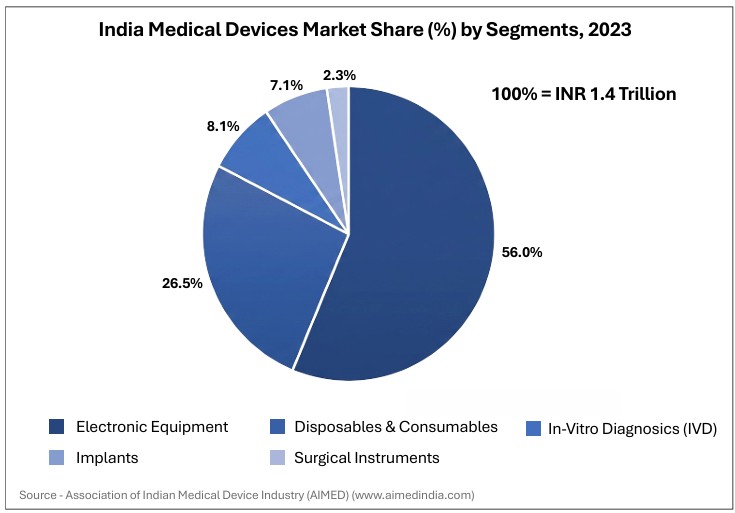
  • India’s medical devices sector was valued at about INR 1.4 trillion in 2023 and is projected to more than triple to around INR 4.6 trillion by 2030
  • India’s drugs and pharmaceuticals exports grew by 59% between FY19 and FY25, increasing from INR 1.5 trillion to INR 2.5 trillion
  • India’s domestic medical device manufacturing has expanded significantly, with its share in meeting domestic demand rising from 10% to 30% over the past five years
  • India produces around 20% of advanced Class-C medical devices domestically, offering them at 10–40% lower costs compared to imports
  • The Indian MedTech market has been growing steadily at around 15% over the past three years and is projected to capture 10–12% of the global market share over the next 25 years
  • India’s medical device industry comprises over 700 companies, supported by 21 manufacturing clusters across nine states

The sector is largely driven by MSMEs, which account for nearly 90% of the total companies, highlighting its fragmented and small-scale operational structure.
What is Driving the Expansion of India’s Medical Devices ?

The medical devices sector in India is widely recognized as a sunrise industry, driven by strong growth potential and evolving healthcare needs. Growth is being fuelled by rising disease burden, increasing healthcare expenditure, rapid technological advancements and proactive government initiatives aimed at boosting domestic manufacturing and innovation.

The growth of India’s medical devices sector is primarily driven by a rapidly expanding and aging population, along with rising per capita income and disposable income levels. Increasing demand for healthcare infrastructure, diagnostic services, insurance coverage, and wider access to medical care is further accelerating market expansion. As per Press Information Bureau (PIB), India’s senior citizen population is expected to reach approximately 230 million by 2036, accounting for around 15% of the total population. 
What are the Key Segments of India’s Medical Devices?

Electronic Instrument

  • Electronic equipment in medical devices integrates advanced sensors, microprocessors and wireless technology to monitor, diagnose and treat patients.
  • It includes medical devices such as diagnostic imaging (MRI, CT), patient monitoring systems, ventilators, etc.
  • Large MNCs like GE Healthcare, Philips Healthcare, Schiller Healthcare, Danaher Corporation, Roche Diagnostics, etc. have a major presence in these segments.

Disposables & Consumables

  • This segment includes products such as bandages, dressings, sutures, syringes, disposable catheters, gloves and blood bags.
  • These devices are typically manufactured using relatively simple processes like moulding, extrusion, coating, basic assembly and sterilization.
  • Due to low entry barriers, the segment is highly competitive with a large number of players.

Implants

  • This category comprises products such as knee and hip implants, artificial joints and dental fixtures.
  • It primarily includes high-risk, technologically advanced devices that require stringent regulatory approvals and precision manufacturing.

In-Vitro Diagnostics

  • This segment includes products such as diagnostic reagents, chemicals, calibrators and control kits.
  • These devices are used for laboratory testing and disease diagnosis, playing a critical role in clinical decision-making.

Surgical Instruments

  • The surgical instruments segment includes products such as forceps, scissors, scalpels, retractors and minimally invasive instruments.

India has a strong export base in this segment, particularly driven by MSMEs, although the market remains fragmented.

What are the Key Government Initiatives Shaping India?

Supportive Production-Linked Incentive (PLI) Scheme

  • Under the Production Linked Incentive Scheme for Medical Devices, 26 projects have been approved.
  • The scheme has a financial outlay of INR 34.2 billion, over a period of FY 2020-21 to FY 2027-28.
  • The initiative aims to drive growth and innovation in the MedTech industry and position India as a global hub for medical device manufacturing and innovation.

National Medical Devices Policy

  • The Union Cabinet approved the National Medical Devices Policy (2023) on April 26, 2023.
  • The policy aims to support the structured growth of the medical devices sector while ensuring access, affordability, quality and innovation in healthcare.
  • It is expected to expand India’s medical devices market from INR 1,042 billion to INR 4,736.5 billion by 2030.

Medical Device and Diagnostics Mission Secretariat (MDMS)

  • Indian Council of Medical Research (ICMR) has established the Medical Device and Diagnostics Mission Secretariat (MDMS) to promote Make-in-India medical device development and strengthen the clinical validation ecosystem.
  • It focuses on promoting indigenous manufacturing of cost-effective medical devices to strengthen India’s healthcare sector.
  • The program also seeks to reduce import dependence through a mission-mode, consortium-based approach involving industry, academia and research institutions.

What Major Trends Are Transforming the Indian Medical Devices Industry?

Strong Government Support & Initiatives

  • To promote domestic manufacturing and reduce import dependence, the Government of India introduced the Production Linked Incentive Scheme for Medical Devices, which offers financial incentives based on incremental sales of locally manufactured products.
  • The government has launched an INR 5 billion scheme to boost domestic production through common infrastructure, component manufacturing subsidies and clinical study support.

Low Cost of Manufacturing

    • India is rapidly emerging as a global hub for cost-effective medical device manufacturing, with products priced 10%–50% lower than imports.
    • India offers low-cost manufacturing and skilled labour, making it competitive for both domestic supply and exports.

Potential Export Hub for Medical Devices

    • India is rapidly emerging as a global hub for cost-effective medical device manufacturing, with products priced 10%–50% lower than imports.
    • India’s medical devices exports reached INR 384.7 billion in FY25, with the government aiming to increase its global market share from 1.6% to around 12% in the coming years.
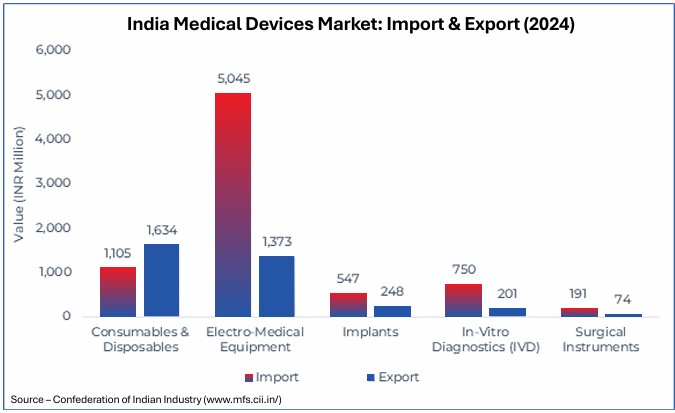
    • The United States and Germany are key export destinations, while the United States and China remain major sources of imports.

Why Invest in India’s Medical Devices Industry?

Digital Health & Smart MedTech Integration  

  • Growth in telemedicine and remote patient monitoring is driving demand for portable and wearable medical devices.
  • Launched by the Ministry of Health and Family Welfare, eSanjeevani is India’s flagship digital health initiative addressing doctor shortages, hospital burden and fragmented medical records.
  • It has enabled over 342 million consultations, connecting providers across 131,000+ Ayushman Arogya Mandirs and nearly 17,000 higher care centers, making it the world’s largest primary care telemedicine platform.

Demographic Shift & Rising Disease Burden

  • Rising prevalence of chronic diseases such as diabetes and cardiovascular conditions is increasing demand for diagnostics, implants and long-term patient monitoring devices.
  • For instance, as per the International Diabetes Federation (IDF), in 2024, Diabetes affects approximately 10.5% of the adult population in India.
  • Additionally, Cardiovascular Diseases (CVDs) are the leading cause of mortality in India, accounting for nearly 25% of all deaths, with a pooled prevalence of 11% among adults.

Future Outlook of India Medical Devices Industry

The Indian medical devices industry is set for exponential growth, driven by policy support, increasing healthcare demand and technological innovation. While import dependency remains a challenge, it also creates significant opportunities for domestic manufacturing and foreign investment. Companies that align with India’s regulatory framework and leverage cost advantages will gain a strong competitive edge. As the sector evolves, strategic advisory and compliance expertise will play a critical role in ensuring successful market entry and long-term growth.

Businesses can explore UJA Global Advisory for end-to-end support in India entry and compliance.

Frequently Ask Questions

India’s medical devices market was valued at around INR 1.4 trillion in 2023 and is expected to grow significantly by 2030.

India relies on imports mainly for high-end and technologically advanced devices due to limited domestic manufacturing capabilities in these segments. However, this is improving through government initiatives like PLI schemes, medical device parks and regulatory support. Increasing investments and innovation in India are helping reduce reliance on imports and turning the country into a growing manufacturing hub.

In-vitro diagnostics, electronic medical devices, and implants are among the fastest-growing segments due to rising disease burden and technological advancements.

Major initiatives include the PLI Scheme, National Medical Devices Policy 2023, and regulatory support for medical device clusters.

Yes, due to strong demand growth, cost advantages, policy support & export potential, India is considered a highly attractive market for investment.

Looking to enter or expand in India? Partner with UJA Global Advisory for end-to-end support across market entry, regulatory compliance & strategic growth, ensuring a smooth and successful expansion journey.

Our Team

Meet Our Experts

Download PDF