
Read Time: 6 min

Market Reports

India’s Pharmaceuticals Industry

Pharmaceuticals Industry

Quick Facts: India’s Pharmaceuticals Industry

  • India is the world’s largest supplier of generic medicines, accounting for around 20% of the global supply
  • With 9 of the world’s top 25 generic drug manufacturers based in India, the country produces 500+ Active Pharmaceutical Ingredients (APIs) and over 60,000 generic brands spanning 60 therapeutic categories
  • India’s pharmaceutical exports reached USD 30.4 billion (INR 2.6 trillion) in FY 2024–25, with the USA and Europe as key markets. The industry aims to grow into a USD 450 billion (INR 38.5 trillion) market by 2047
  • The pharmaceutical industry comprises several key segments, including generic drugs, bulk drugs (APIs), vaccines, Over-The-Counter (OTC) medicines, formulation drugs, biosimilars and biologics
  • Its top export destinations include the USA, Belgium, South Africa, the UK and Brazil
  • India remains a global leader in the production and supply of Bacillus Calmette-Guérin (BCG), Diphtheria, Pertussis, Tetanus (DPT) and measles vaccines
  • With 94,000+ clinical trials registered by 2025, India’s pharmaceutical sector is a key driver of cost-efficient innovation
  • Indian pharmaceutical companies are expected to record 9–11% revenue growth in FY25, driven by strong performance in key markets such as the United States, Europe and emerging economies

Overview of the Indian Pharmaceuticals Industry

India’s pharmaceutical market has established itself as a major global player, underpinned by its role as the world’s “pharmacy” and a robust manufacturing base. Key strengths include a vast portfolio of 60,000+ generic brands, extensive API production and strong compliance with international quality standards. India additionally supplies a significant share of global vaccines, contributing substantially to immunization efforts through UNICEF and WHO channels.

Strategic government policies, including Production-Linked Incentive (PLI) schemes, Foreign Direct Investment (FDI) facilitation and regulatory reforms, are further supporting sector growth. These measures aim to strengthen domestic API manufacturing, reduce import dependence and encourage higher-value segments such as biosimilars, specialty generics, and biologics. The Indian biosimilars market, valued at around INR 437 crore (INR 4.4 billion) as of May 2025, is projected to expand to approximately INR 1,649 crore (INR 16.5 billion) by 2034, growing at a CAGR of 14.2%.

Moreover, there is a growing emphasis on innovation, clinical trial capacity and regulatory cooperation to enhance global market access. With strong export growth, diversified product capabilities and continued investment, the Indian pharmaceutical sector is well poised for sustained expansion and enhanced global impact in both generics and emerging therapeutic areas.
India’s Pharmaceuticals Industry by Drug Category

Branded Generic

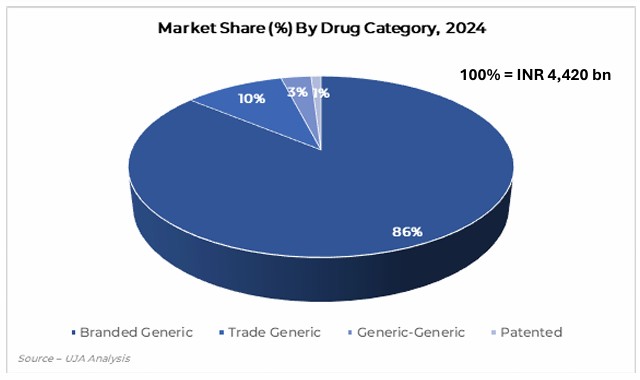
  • Branded Generics dominate the Indian Pharmaceutical Market (IPM), accounting for 87% of total market value.
  • In 2024, this segment was valued at approximately INR 2,084 billion and is projected to grow at a CAGR of 8.5%, reaching around INR 3,710 billion by 2030.
  • This growth is driven by strong physician prescribing preferences, brand recall and expanding access to healthcare.

Trade Generic

  • Trade Generics represent a structurally fast-growing segment of the Indian Pharmaceutical Market, valued at approximately INR 240 billion in 2024 and accounting for 10% of total IPM value.
  • The segment is expected to grow at a strong CAGR of 16%.
  • This growth is driven by aggressive pricing, expanding private-label pharmacy networks and increasing doctor and pharmacist acceptance.

Generic-Generics

  • The Generic-Generics segment, while currently accounting for a modest 3% share of the IPM, is positioned for meaningful expansion.
  • This growth is underpinned by the government’s push to improve access to affordable medicines, most notably through initiatives such as Jan Aushadhi stores, targeting underserved and price-sensitive populations.

Patented Drugs

  • Patented drugs currently constitute a relatively small portion of the Indian Pharmaceutical Market; however, they represent a high-value, innovation-led growth opportunity.
  • Increasing disease complexity, rising diagnosis rates for chronic and specialty conditions, and gradual improvement in patient affordability and insurance coverage are expected to support sustained growth.

Government Initiatives

Production Linked Incentive (PLI) Scheme

  • The PLI Scheme for Pharmaceuticals is aligned with the Atmanirbhar Bharat initiative aimed at strengthening India’s manufacturing capabilities and boosting exports across ten sectors, as approved by the Union Cabinet on 24 February 2021.
  • The scheme is implemented over the period FY 2020–21 to FY 2029–30 with a total financial outlay of INR 6,940 crore (INR 69.4 billion).
  • Financial incentives will be provided for six years based on sales of 41 identified products.
  • Under the medical devices scheme, 21 approved projects have commenced production of 54 medical devices, including advanced equipment such as LINACs, MRI and CT scanners, heart valves, stents, dialyzer machines, C-arms, cath labs, mammographs and MRI coils.

Ayushman Bharat Digital Mission (ABDM)

  • Launched in September 2021, the Ayushman Bharat Digital Mission (ABDM) aims to enable interoperable health data across the healthcare ecosystem and create longitudinal electronic health records for every citizen.
  • As of February 2025, over 3.6 lakh health facilities and 5.6 lakh healthcare professionals are registered on ABDM’s Health Facility Registry (HFR) and Healthcare Professional Registry (HPR), respectively.
  • As of December 2025, approximately 120 million families are enrolled, with cumulative hospital admissions amounting to INR 1.6 trillion.

Scheme for Promotion of Research and Innovation in Pharma MedTech Sector (PRIP)

  • The scheme comprises two key components:
    • Component A: Strengthening research infrastructure through the establishment of Centers of Excellence (CoEs) at the National Institutes of Pharmaceutical Education and Research (NIPERs).
    • Component B: Promotion of research and innovation in the Pharma and MedTech sector.
  • The scheme has a total financial outlay of INR 500 million, comprising INR 70 million for establishing CoEs at seven NIPERs and INR 420 million allocated to accelerate investments across the sector’s R&D ecosystem.

The scheme is approved for a five-year duration, spanning FY 2023–24 to FY 2027–28.

Megatrends in the Pharmaceuticals Industry

Shift from “Make in India” to “Develop in India”

  • The Indian pharmaceutical industry is evolving from a “Make in India” focus toward a “Develop in India” paradigm, marked by rising investments in research and development across complex generics, biosimilars and novel therapies.
  • Strong government backing through initiatives such as the PRIP scheme is accelerating this transformation, strengthening indigenous innovation capabilities and positioning India as an emerging global hub for pharmaceutical research and innovation.

Integration of AI

  • Indian API makers are adopting AI/ML in manufacturing, sustainable/flexible production methods and advanced process technologies.
  • AI initiatives, such as those at Novartis’ Hyderabad unit, have improved participant selection, delivering up to 20% gains in cost efficiency and enrolment speed, while cutting database lock times by over 50%.
  • As part of the National Strategy for AI, launched by NITI Aayog initiative, multiple Centres of Excellence for AI in Healthcare (AI-CoEs) have been announced in collaboration with leading institutions, including AIIMS Delhi, AIIMS Rishikesh and PGIMER Chandigarh.

Why Invest in India’s India’s Pharmaceuticals Industry?

Robust Export Demand

  • Pharmaceuticals rank among the top ten most attractive sectors for foreign investment in India.
  • India also demonstrated its global supply strength by exporting around 45 tons and 400 million tablets of hydroxychloroquine to approximately 114 countries worldwide.
  • India’s drugs and pharmaceutical exports reached INR 2.6 trillion in FY25, up from INR 2.4 trillion in FY24.
  • As of May 2025, India supplies 55–60% of UNICEF’s vaccines and meets 99% of WHO’s DPT vaccine demand, along with 52% of BCG and 45% of measles vaccines.

Liberal Foreign Direct Investment (FDI) Norms

  • There is 100% FDI permitted under the automatic route in greenfield pharma and up to 74% allowed in brownfield projects.
  • India’s pharmaceutical sector attracted USD 891 million (INR 761.5 billion) in equity FDI in FY 2024–25.
  • Medical and surgical appliances received over USD 3.9 billion (INR 333.3 billion) in cumulative Foreign Direct Investment (FDI) between April 2000 and March 2025.
  • Supportive FDI policies continue to draw global capital into Contract Development & Manufacturing Organization (CDMOs) and Contract Research Organization (CROs), strengthening India’s position as a long-term hub for pharma R&D and manufacturing.

Low Cost of Production

  • The Indian pharmaceutical industry has thrived on the back of cost-efficient manufacturing, a strong R&D ecosystem and a highly skilled workforce specializing in drug development and production.
  • Capital expenditure for API manufacturing in India is approximately 28.5% lower compared to manufacturing for other global markets.
  • Under the Pradhan Mantri Bhartiya Janaushadhi Pariyojana (PMBJP), dedicated outlets known as Jan Aushadhi Kendras have been established nationwide to offer medicines priced 50–80% lower than leading branded alternatives.

Our Team

Meet Our Experts

Download PDF