

India | Japan | Italy | Spain | France | German | UAE
Dear Reader,
The Company Secretary Team at UJA is pleased to present a comprehensive overview of Downstream Investment under the Foreign Exchange Management Act, 1999 (FEMA), a key aspect of India’s foreign investment framework that governs indirect foreign investment through Indian entities.
This article aims to provide a clear understanding of the concept and regulatory framework governing downstream investment under the Foreign Exchange Management (Non-Debt Instruments) Rules, 2019. It explains when an investment qualifies as downstream investment, the principles of foreign ownership and foreign control, and the circumstances in which such investments are treated as indirect foreign investment under FEMA.
Through this write-up, we seek to simplify the regulatory provisions relating to downstream investment while highlighting the importance of proper transaction structuring, timely reporting, and adherence to FEMA and FDI policy requirements. Understanding these provisions is essential for businesses undertaking acquisitions, corporate restructurings, or investment activities involving foreign participation, as non-compliance may result in regulatory consequences.
We hope you find this article informative and useful in enhancing your understanding of downstream investment regulations and the compliance framework governing indirect foreign investment in India.
For feedback or topic suggestions, please write to us at cs@uja.in.
As India continues to attract significant foreign investment, the regulatory framework governing such investments has become increasingly important. One concept that often creates confusion among businesses and professionals is Downstream Investment.
While foreign investors may invest directly in an Indian company, what happens when that Indian company further invests in another Indian entity? This is where the concept of downstream investment comes into play.
This article explains the meaning, applicability, compliance requirements and key considerations relating to downstream investment under the Foreign Exchange Management Act, 1999 (FEMA).
Downstream investment refers to an investment made by an Indian entity, which has already received foreign investment, into another Indian company or LLP by way of subscription to or acquisition of capital instruments.
In simple terms, it is indirect foreign investment flowing through an Indian entity into another Indian entity.
Example
Suppose a foreign company invests in ABC Private Limited, an Indian company. ABC Private Limited subsequently acquires shares in XYZ Private Limited, another Indian company.
Although the investment in XYZ is made by an Indian company, it is treated as indirect foreign investment because the investing company itself has foreign investment.
The objective of downstream investment regulations is to ensure that foreign investment restrictions are not circumvented through intermediary Indian companies.
Without these regulations, foreign investors could indirectly invest in sectors where direct foreign investment is restricted simply by routing funds through an Indian entity.
Therefore, FEMA treats eligible downstream investments as foreign investment and subjects them to the same regulatory framework applicable to direct FDI.
Not every Indian company with foreign investment falls under the indirect foreign investment regime.
The downstream investment is regarded as indirect foreign investment where the investing Indian entity is:
Foreign Ownership
An Indian company is considered foreign-owned when persons resident outside India beneficially holds more than 50% of its equity instruments.
Foreign Control
A company is regarded as foreign-controlled when non-residents have the right to:
Therefore, even where foreign shareholding is below 50%, the company may still be considered foreign-controlled if effective control rests with non-residents.
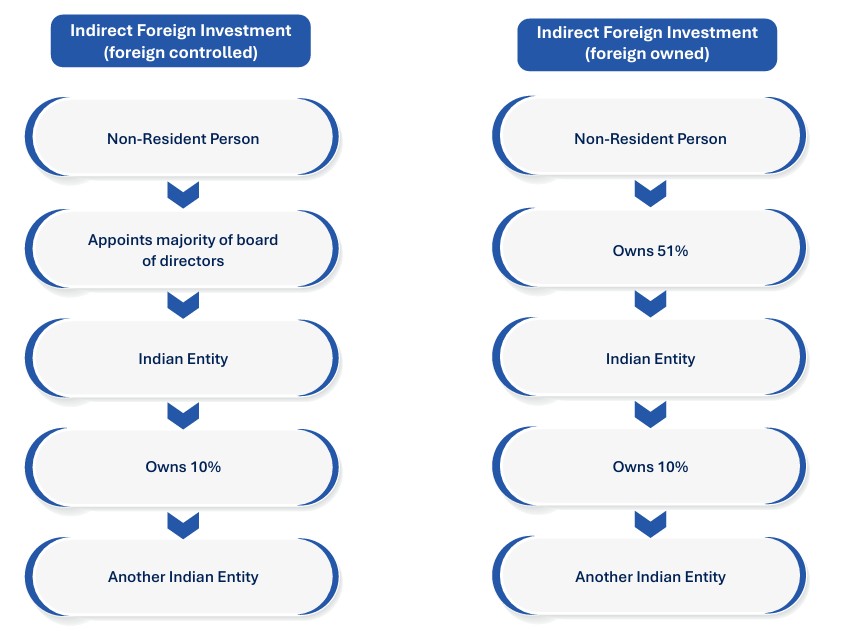
One of the most significant principles governing downstream investment is that all conditions applicable to direct foreign investment also apply to indirect foreign investment.
Accordingly, the investee company must comply with:
The underlying regulatory principle is straightforward:
What cannot be done directly cannot be done indirectly.
An Indian entity making downstream investment should generally finance the investment through:
The regulations do not allow the use of domestic borrowings solely for making downstream investments.
Corporate Approvals
Before making downstream investment, the investing company should ensure:
These approvals are essential to demonstrate proper corporate governance and regulatory compliance.
Downstream investment attracts mandatory reporting requirements under FEMA.
The investing Indian entity is required to intimate the Department for Promotion of Industry and Internal Trade (DPIIT) regarding the downstream investment within within 30 (thirty) days of such investment.
After allotment of equity instruments, Form DI must be filed with the Reserve Bank of India through the FIRMS Portal within 30 (thirty) days from the date of allotment of equity instruments.
Failure to comply with reporting requirements may attract penalties under FEMA.
The responsibility for ensuring compliance rests primarily with the Indian company making the downstream investment.
Every year:
Where any qualification is made by the statutory auditor, the matter is required to be reported to the Reserve Bank of India.
The FDI Policy provides a limited exception in the case of wholly owned subsidiaries.
Where the downstream investee is a 100% wholly owned subsidiary, the indirect foreign investment is generally limited to the extent of foreign investment existing in the holding company rather than treating the entire investment as indirect foreign investment.
This exception ensures that the downstream investment reflects the actual foreign ownership in the parent company.
Practical Considerations
Before undertaking a downstream investment, businesses should evaluate:
Careful planning at the transaction stage helps avoid regulatory issues and ensures seamless compliance under FEMA.
It’s when an Indian entity that already has foreign investment further invests in another Indian company or LLP by subscribing to or acquiring capital instruments. In simple terms, it’s indirect foreign investment flowing through one Indian entity into another.
Only when the investing Indian entity is either foreign-owned (non-residents hold more than 50% equity) or foreign-controlled (non-residents can appoint majority directors or influence key management/policy decisions), even if their shareholding is below 50%.
No. Downstream investments must be funded through funds received from abroad or internal accruals (post-tax profits transferred to reserves), not through domestic loans.
Two mandatory filings: intimation to DPIIT within 30 days of the investment and filing of Form DI with the RBI via the FIRMS Portal within 30 days of allotment of equity instruments.
Yes. Where the downstream investee is a 100% wholly owned subsidiary, indirect foreign investment is generally capped at the extent of foreign investment already existing in the holding company, not the entire investment amount.
Downstream investment is a critical aspect of India’s foreign investment framework. Although the investment is made by an Indian entity, FEMA may still regard it as foreign investment where foreign ownership or control exists in the investing company.
Businesses planning acquisitions, group restructurings, or investments through Indian subsidiaries should carefully evaluate downstream investment provisions to ensure compliance with FEMA, the Foreign Exchange Management (Non-Debt Instruments) Rules, 2019 and the Consolidated FDI Policy.
Understanding these regulations not only helps in avoiding penalties but also enables businesses to structure investments efficiently while remaining fully compliant with India’s foreign exchange laws.
Downstream investment structuring isn’t just a compliance checkbox, get it wrong, and it can invite regulatory action under FEMA.
At UJA Global Advisory, our Company Secretarial team helps you structure it right, from Board approvals to Form DI filings.
UJA Global Company Secretary team specializes in offering a wide range of corporate compliance and governance solutions, ensuring seamless regulatory adherence for businesses of all sizes.
Our Comprehensive Services Include:
UJA Global supports businesses in navigating the complexities of corporate laws, regulatory frameworks and compliance mandates across various jurisdictions. With operations spanning France, Germany, Japan, Spain and more, we help companies ensure seamless corporate governance and risk management.